

Tesla Coil Plasma Speaker vs. Normal Speaker: The Physics
Imagine hearing music produced not by a vibrating cone or a stretched membrane, but by the air itself, crackling, ionized, and alive with electricity. The tesla coil speaker is one of the most astonishing intersections of high-voltage physics and acoustic engineering ever conceived. In this article, we break down the fundamental science behind how a plasma speaker works, how it compares to a conventional speaker, and why this technology continues to captivate scientists, engineers, and curious minds alike. Whether you have encountered a bluetooth tesla coil speaker at a science fair or simply stumbled across one online, the physics behind it is well worth understanding.
How a Conventional Speaker Produces Sound

To appreciate what makes a tesla coil speaker so remarkable, we must first understand how a traditional speaker operates. A conventional speaker relies on a precisely engineered sequence of electromagnetic events to convert an electrical audio signal into physical sound. At the heart of every standard speaker is a voice coil, a tightly wound loop of wire suspended within a permanent magnetic field. When an alternating electrical current representing the audio signal passes through this coil, it experiences a force according to Ampere's Law, pushing and pulling the coil back and forth in rapid succession.
This mechanical motion is transferred directly to a cone or diaphragm, typically made of paper, plastic, or woven fabric, which is attached to the voice coil. As the cone moves forward and backward, it displaces the surrounding air molecules, creating regions of compression and rarefaction, the pressure waves we perceive as sound. The fidelity of the sound depends heavily on how accurately the cone can replicate the original waveform of the electrical signal, and this is where physical limitations begin to emerge.
Because the cone is a physical object with mass and stiffness, it introduces what engineers call mechanical inertia. At higher frequencies, the cone cannot always respond fast enough to keep up with the rapid oscillations of the audio signal, leading to distortion, resonance peaks, and a gradual rolloff in high-frequency performance. This is why high-end audio systems use separate tweeters, woofers, and crossover networks, each component is optimized for a specific frequency range to compensate for the inherent limitations of moving-mass transduction.
The Fundamentals of Tesla Coil Technology
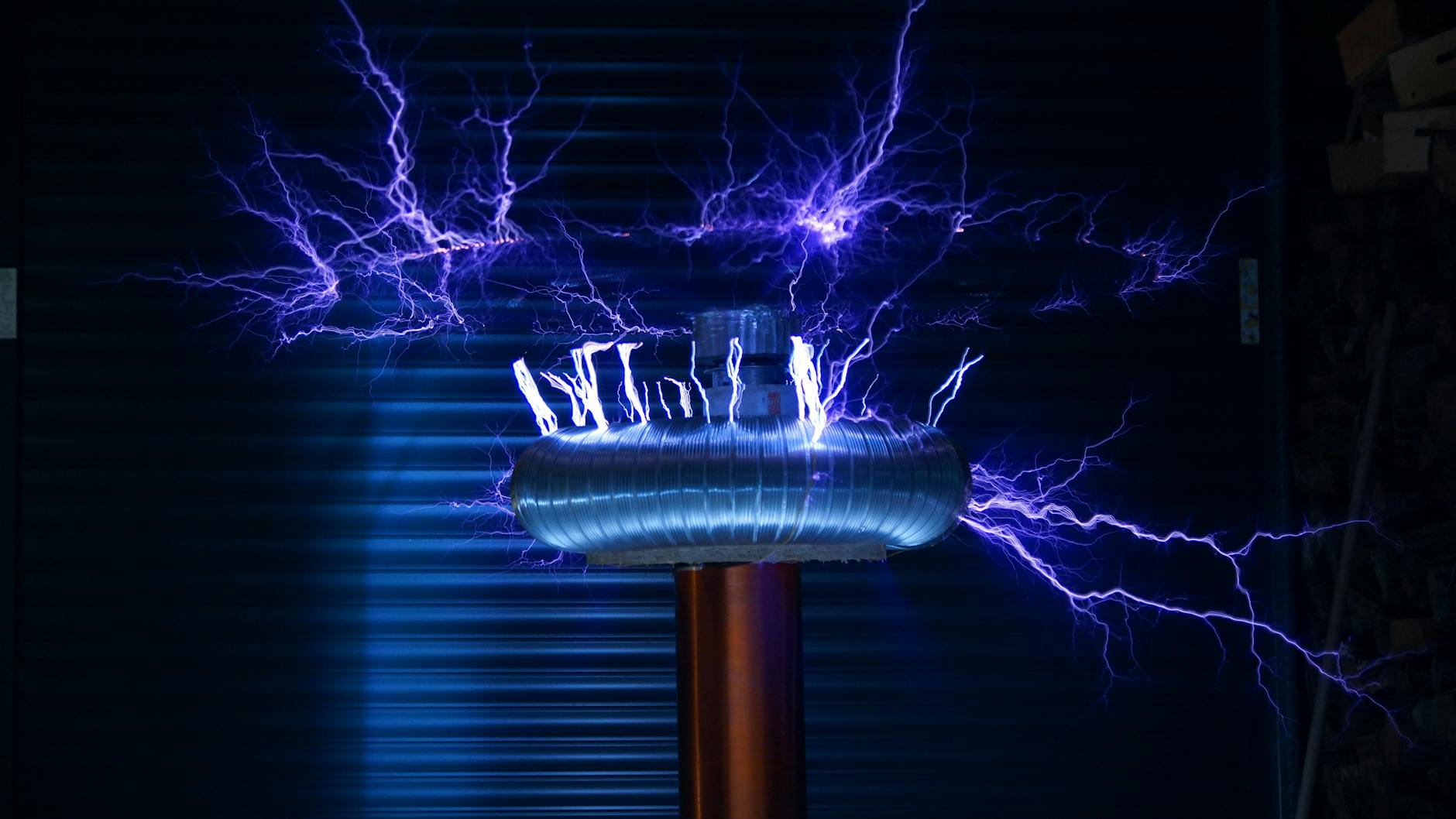
Before we can understand how a tesla coil produces sound, we need to revisit what a Tesla coil actually is. Invented by Nikola Tesla in the 1890s, the Tesla coil is a resonant transformer circuit designed to produce extremely high voltages at high frequencies. It consists of a primary coil, a secondary coil, and a capacitor, all tuned to resonate at the same frequency so that energy transfers between them with remarkable efficiency. The result is a device capable of generating electrical potentials of thousands, sometimes millions, of volts, producing dramatic electrical discharges into the surrounding air.
Modern Tesla coils used in plasma speakers are typically solid-state designs, meaning they use transistors or MOSFETs instead of spark gaps to control the high-frequency switching. This solid-state architecture is far more precise and controllable than older mechanical spark-gap designs, which is what makes audio modulation possible in the first place. The switching frequency of the transistors can be varied rapidly and accurately in response to an incoming audio signal, giving engineers the ability to encode music directly into the electrical behavior of the arc.
You can explore the fascinating world of high-voltage decorative science through our collection of Tesla coil speakers, which showcases some of the most visually and acoustically stunning examples available today. These devices sit at the crossroads of laboratory science and living-room décor, making them a uniquely compelling addition to any science-inspired space.
How a Plasma Speaker Produces Sound Without a Membrane

The central miracle of the plasma speaker, and the question most people ask first, is this: how does it produce sound when there is no cone, no diaphragm, and no moving mechanical part? The answer lies in the physics of arc discharge and air ionization. When the Tesla coil fires a high-voltage discharge into the surrounding air, it strips electrons from air molecules, creating a plasma, a superheated, electrically conductive gas. This plasma channel expands and contracts almost instantaneously in response to changes in the electrical discharge.
When the electrical power of the arc is modulated at audio frequencies, meaning the intensity of the arc is made to increase and decrease in sync with a musical waveform, the plasma expands and contracts at those same frequencies. This rapid volumetric change in the plasma channel directly displaces the surrounding air, generating pressure waves that travel outward as sound. In essence, the ionized air itself becomes the acoustic transducer, replacing the physical cone entirely. This is the core principle behind understanding plasma speaker how it works: there is no intermediate mechanical step between the electrical signal and the sound wave.
The implications of this design are profound. Because there is no physical mass being accelerated and decelerated, the system has virtually no mechanical inertia. The plasma responds to changes in electrical power at speeds that approach the theoretical limits of the medium, making it extraordinarily accurate at reproducing high-frequency content. This is why audiophiles and physicists alike find the tesla coil sound science so compelling, the acoustic transduction mechanism is, in many ways, closer to ideal than anything a physical membrane can achieve.
Frequency Modulation and Audio Signal Encoding

Understanding how audio is encoded into a Tesla coil arc requires a brief exploration of modulation theory. In a solid-state musical tesla coil, the high-frequency switching of the transistors operates at what is called the carrier frequency, typically in the range of 100 kHz to several MHz. This carrier frequency is far above the range of human hearing, which tops out at approximately 20 kHz. The audio signal is then superimposed onto this carrier through a process called pulse-width modulation (PWM) or frequency modulation, depending on the specific circuit design.
In pulse-width modulation, the duration of each high-voltage pulse is varied in proportion to the instantaneous amplitude of the audio signal. When the audio waveform calls for a louder sound, the pulses are wider; when it calls for a quieter sound, the pulses are narrower. The plasma arc responds to these varying pulse widths by expanding more or less vigorously on each cycle, and because the carrier frequency is so far above the audible range, only the modulated envelope, the audio signal itself, is perceived by the human ear. The result is remarkably clean, high-fidelity sound reproduction, particularly in the mid and high frequency ranges.
Modern bluetooth tesla coil speaker designs take this concept even further by incorporating wireless audio receivers directly into the control circuitry. A Bluetooth module receives the audio stream from a smartphone or other device, converts it into an analog or digital signal, and feeds it into the modulation stage of the solid-state Tesla coil. This means the entire process, from streaming a song on your phone to hearing it reproduced in crackling plasma arcs, is seamlessly integrated, making the musical tesla coil bluetooth experience both technologically sophisticated and remarkably user-friendly.
Why Plasma Speakers Excel at High Frequencies, and Where They Fall Short

One of the most scientifically interesting aspects of plasma speaker technology is its extraordinary high-frequency performance. Because the plasma has effectively zero mechanical mass, it can respond to audio frequencies across the entire audible spectrum without the resonance peaks, phase distortion, or rolloff that afflict physical cones. In controlled listening tests, plasma speakers consistently demonstrate near-zero harmonic distortion at frequencies above 5 kHz, a range where even the finest conventional tweeters begin to show measurable degradation. This makes them particularly prized for reproducing the delicate overtones of acoustic instruments, cymbals, and vocal sibilance.
However, plasma speakers are not without their limitations, and intellectual honesty requires us to acknowledge them clearly. The most significant weakness is in the low-frequency range. Because low bass frequencies require large volumes of air to be displaced, something a tiny plasma arc simply cannot achieve on its own, plasma speakers produce very little energy below approximately 200 Hz. Most practical plasma speaker systems are therefore paired with conventional subwoofers to cover the bass frequencies, creating a hybrid system that leverages the strengths of both technologies.
There are also safety and environmental considerations. The high-voltage arcs produce ozone and nitrogen oxides as byproducts of air ionization, which can be irritating in poorly ventilated spaces. The electromagnetic interference generated by the coil can also affect nearby electronic devices if the system is not properly shielded. These are engineering challenges that manufacturers of consumer-grade devices have largely addressed, but they are worth understanding for anyone interested in the deeper tesla coil sound science.
Tesla Coil Speakers as Scientific Décor and Educational Tools

Beyond their acoustic performance, tesla coil plasma speakers occupy a unique cultural and aesthetic space. They are simultaneously working scientific instruments, conversation pieces, and living demonstrations of electromagnetic physics. Watching a musical arc dance in perfect synchrony with a piece of music is an experience that communicates the beauty of physics more viscerally than any textbook diagram ever could. For educators, science communicators, and curious individuals alike, a tesla coil speaker is one of the most effective ways to make high-voltage electromagnetic theory tangible and emotionally resonant.
If you are drawn to the broader world of electromagnetic and physical science as decoration, we encourage you to explore our physical science collection, which gathers some of the most elegant demonstrations of physics principles available for the home or office. From resonance to electromagnetism, each piece in this collection tells a scientific story in a visually compelling way. A tesla coil speaker fits naturally within this tradition, it is not merely a gadget, but a window into the fundamental forces that govern our universe.
For those who want to begin their journey with a specific, highly regarded model, we recommend taking a look at our bluetooth musical tesla coil speaker, which combines solid-state engineering, wireless audio connectivity, and striking visual performance in a single desktop-sized unit. It represents an ideal entry point for anyone eager to experience plasma acoustics firsthand, whether as a gift, a classroom demonstration, or a centerpiece for a science-inspired living space.
Comparing the Two Technologies Side by Side

To consolidate our understanding, it is helpful to place the two technologies in direct comparison. Both conventional speakers and plasma speakers share the same fundamental goal: converting an electrical audio signal into audible sound pressure waves. But the mechanisms they use to achieve this goal could not be more different. Where a conventional speaker relies on electromagnetic force acting on a physical mass, a plasma speaker relies on the thermodynamic expansion of ionized gas. One is a mechanical process; the other is a plasma-physical one.
The following comparison highlights the key differences between the two approaches:
- Transduction mechanism: Conventional, electromagnetic voice coil moving a cone; Plasma, modulated arc discharge expanding ionized air
- Moving mass: Conventional, significant (cone + coil assembly); Plasma, effectively zero
- High-frequency performance: Conventional, limited by mechanical inertia; Plasma, near-ideal, very low distortion
- Low-frequency performance: Conventional, excellent with appropriate cone size; Plasma, very limited, typically requires subwoofer support
- Distortion profile: Conventional, increases with frequency and volume; Plasma, remains very low at high frequencies
- Byproducts: Conventional, heat from voice coil; Plasma, ozone, nitrogen oxides, electromagnetic interference
- Visual spectacle: Conventional, none; Plasma, dramatic electrical arcs synchronized to music
This comparison makes clear that neither technology is universally superior, each has a domain in which it excels. The conventional speaker remains the workhorse of audio reproduction across nearly every application, while the plasma speaker carves out a remarkable niche in high-frequency accuracy, visual impact, and scientific demonstration. The emergence of bluetooth tesla coil speaker designs has made this technology more accessible than ever, bridging the gap between laboratory curiosity and everyday use.
Conclusion
The tesla coil plasma speaker is more than an audio device, it is a living demonstration of some of the most fascinating principles in electromagnetic and plasma physics, made audible and visible in a single crackling arc. By replacing the physical membrane with ionized air itself, it sidesteps the mechanical limitations that have defined speaker engineering for over a century, achieving a purity of high-frequency reproduction that conventional technology struggles to match. Whether you are drawn to it as a scientist, an audiophile, or simply someone who finds beauty in the intersection of art and physics, the plasma speaker rewards curiosity generously. We invite you to explore our range of tesla coil speakers and discover for yourself what it sounds, and looks, like when electricity becomes music.


Leave a comment
All comments are moderated before being published.
This site is protected by hCaptcha and the hCaptcha Privacy Policy and Terms of Service apply.