

How Does a Perpetual Calendar Work? Math & Science Explained
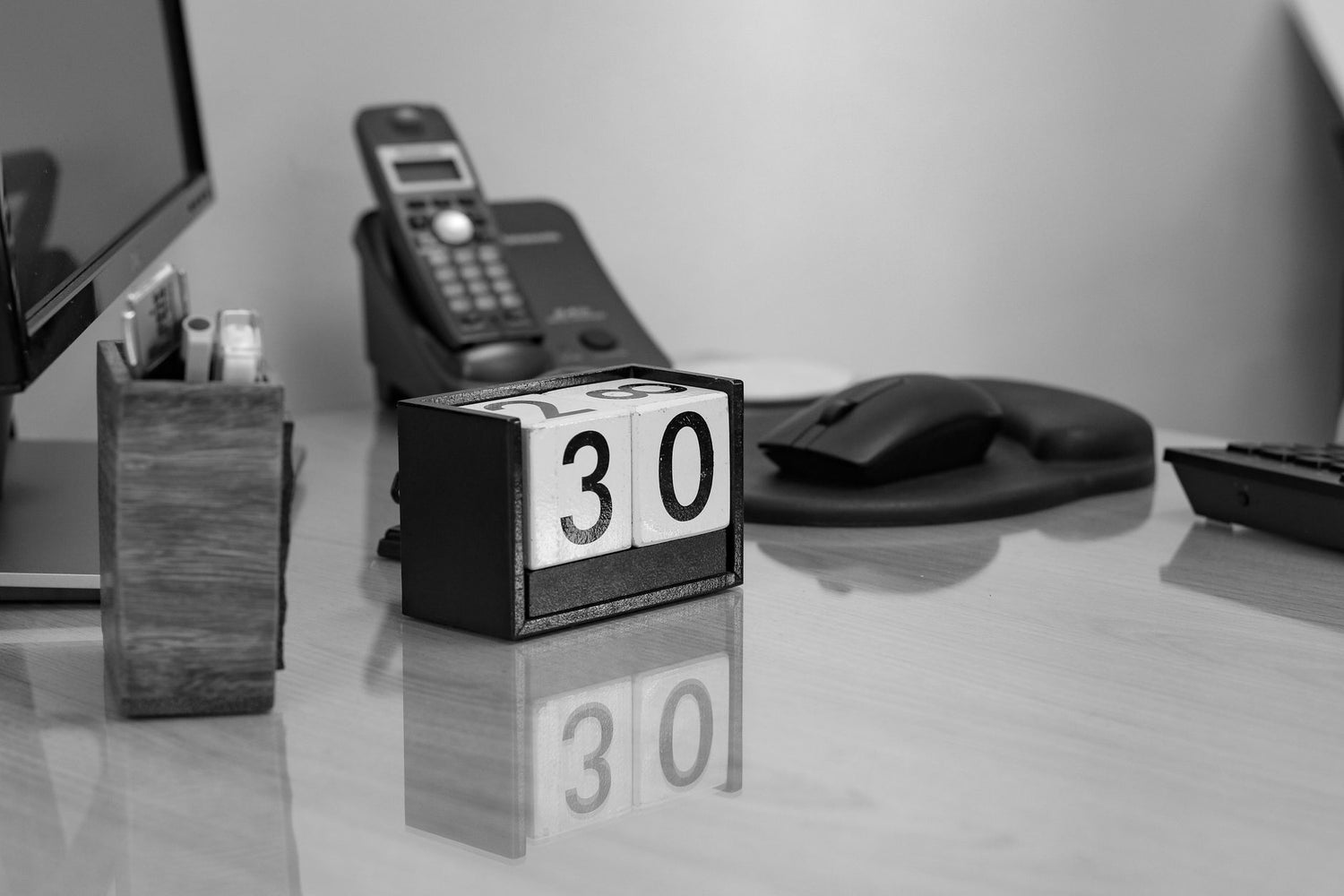
Glance at a desk perpetual calendar and you might see nothing more than a charming decorative object, a few sliding panels, rotating discs, or interlocking blocks displaying today's date. But hidden within that elegant simplicity is a remarkable system of mathematics and astronomical science that has occupied the minds of scholars, watchmakers, and astronomers for centuries. A perpetual calendar is, at its core, a mechanical or logical device capable of tracking every date correctly across months of unequal length, leap years, and centuries, without ever needing to be reset. Understanding how it works is a journey through the history of timekeeping, the quirks of our planet's orbit, and the elegant power of modular arithmetic.
The Gregorian Calendar: A 400-Year Repeating Cycle
Before we can understand a perpetual calendar, we must understand the system it is built upon: the Gregorian calendar. Introduced by Pope Gregory XIII in 1582, the Gregorian calendar was designed to correct the drift that had accumulated in the older Julian calendar, which slightly overestimated the length of the solar year. The Gregorian calendar defines a year as 365.2425 days on average, achieved by applying a specific set of leap year rules that create a grand cycle lasting exactly 400 years. This 400-year cycle is the mathematical backbone upon which every perpetual calendar, mechanical or printed, ultimately rests.
The leap year rules are elegantly layered. A year is a leap year if it is divisible by 4, but if it is also divisible by 100, it is not a leap year, unless it is additionally divisible by 400, in which case it is a leap year. This means that 1900 was not a leap year, but 2000 was. Over the full 400-year cycle, there are exactly 97 leap years, producing a total of 146,097 days. Remarkably, 146,097 is exactly divisible by 7, which means the calendar repeats its day-of-the-week pattern perfectly every 400 years. This single mathematical fact is what makes a perpetual calendar mathematically possible.
The implications of this cycle are profound. Any date, say, the 14th of March, will fall on the same day of the week in the year 2024 as it did in 1624 and as it will in 2424. Every perpetual calendar, whether a pocket watch complication or a beautifully crafted desk object, is essentially a physical embodiment of this 400-year mathematical truth. The calendar is not magic; it is pure, reproducible arithmetic made tangible.
Leap Year Science: Why Our Calendar Needs a Correction

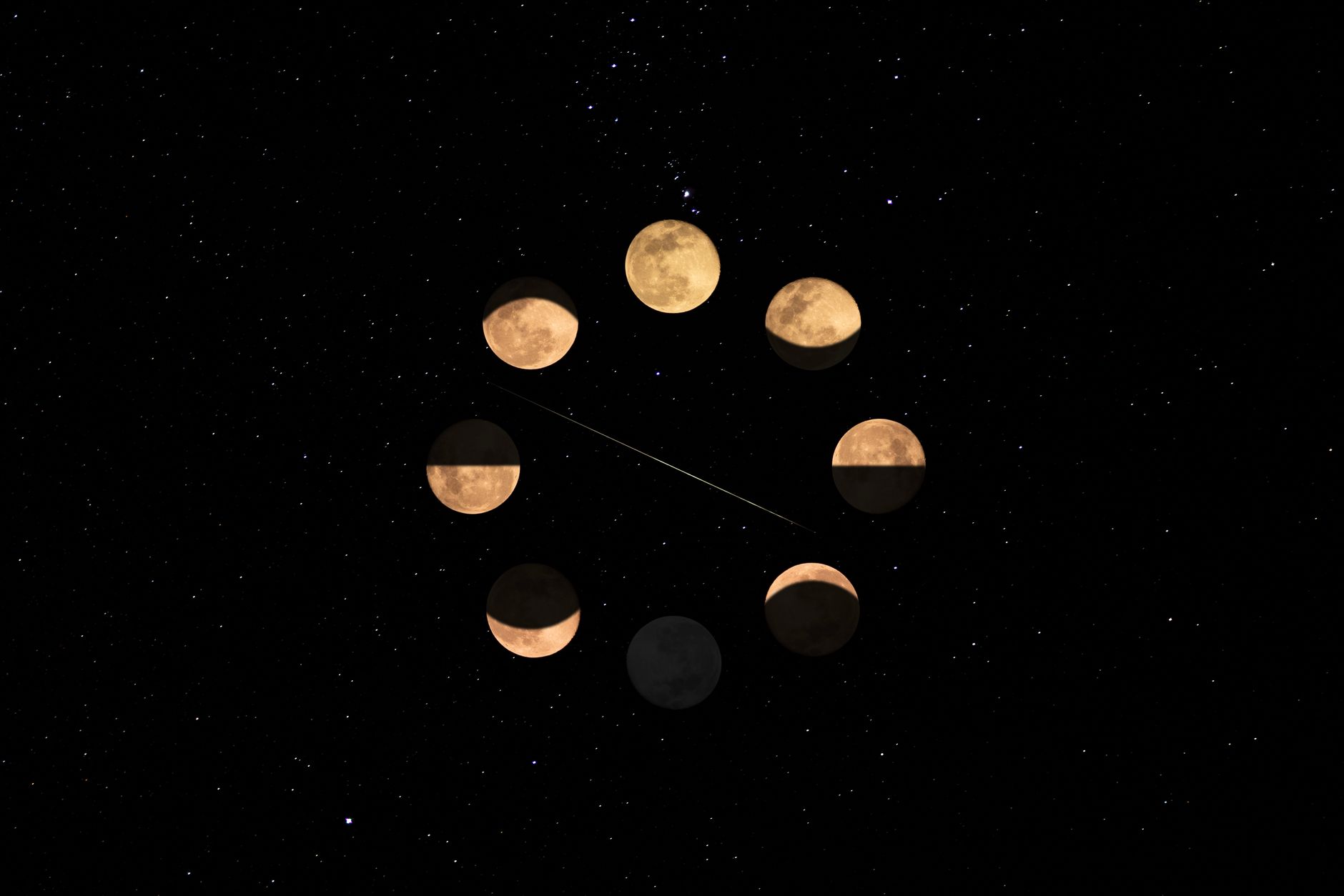
To appreciate why leap years exist at all, we need to look up at the sky. Earth does not orbit the Sun in a perfectly whole number of days. One complete orbit, one tropical year, takes approximately 365.24219 days. If our calendar simply counted 365 days per year and never corrected, the calendar would drift forward by about one day every four years. Within a century, the seasons would be noticeably misaligned with the calendar; within a few thousand years, July would fall in winter in the Northern Hemisphere.
The leap year is the correction mechanism. By inserting an extra day, February 29th, every four years, we compensate for that accumulating quarter-day. But 0.25 days per year is a slight overestimate of the true 0.24219-day surplus. Without further correction, the calendar would gain roughly three extra days every 400 years. The Gregorian century rules, skipping leap years in century years not divisible by 400, remove exactly those three surplus days, bringing the average year length to within 26 seconds of the true tropical year. It is a correction of extraordinary precision, engineered with nothing more than arithmetic.
This is why leap year science is so central to calendar mathematics. Every perpetual calendar mechanism, whether it uses rotating cams, sliding levers, or printed lookup tables, must encode these correction rules. A device that accounts for the four-year cycle but ignores the century exception will produce errors, and a watchmaker or designer who understands this distinction is working at a genuinely scientific level.
A Brief History of the Perpetual Calendar
The desire to track time automatically, without constant human intervention, is ancient. The Greeks built the Antikythera mechanism around 100 BCE, a bronze geared device capable of predicting astronomical events and tracking calendar cycles with remarkable accuracy. Medieval cathedral clocks across Europe incorporated astronomical displays that tracked the date, the phase of the Moon, and the position of the Sun in the zodiac. These early devices were the philosophical ancestors of the perpetual calendar, driven by the same ambition: to let mathematics do the remembering so that humans do not have to.
The modern mechanical perpetual calendar as we know it in watchmaking is most closely associated with Thomas Mudge, the English horologist who, around 1762, created one of the first documented perpetual calendar pocket watches. Mudge's achievement was to build a mechanical system that automatically advanced the date display to account for months of 28, 29, 30, and 31 days. His design used a series of cams, eccentric rotating discs with lobes of varying heights, each lobe corresponding to a month of the year, with February's cam carrying a special four-year cycle mechanism for the leap year.
Through the 19th and 20th centuries, Swiss and French watchmakers refined these mechanisms into objects of extraordinary complexity. Houses such as Patek Philippe and A. Lange & Söhne developed perpetual calendar movements containing hundreds of parts, all working in concert to advance the date correctly through every month and year. The desk perpetual calendar, a simplified, non-mechanical version using sliding tiles or rotating cylinders, democratized this concept, bringing the elegance of perpetual calendar logic into the home and office as both a functional tool and a decorative statement.
The Mechanics: Cams, Gears, and the 48-Month Wheel

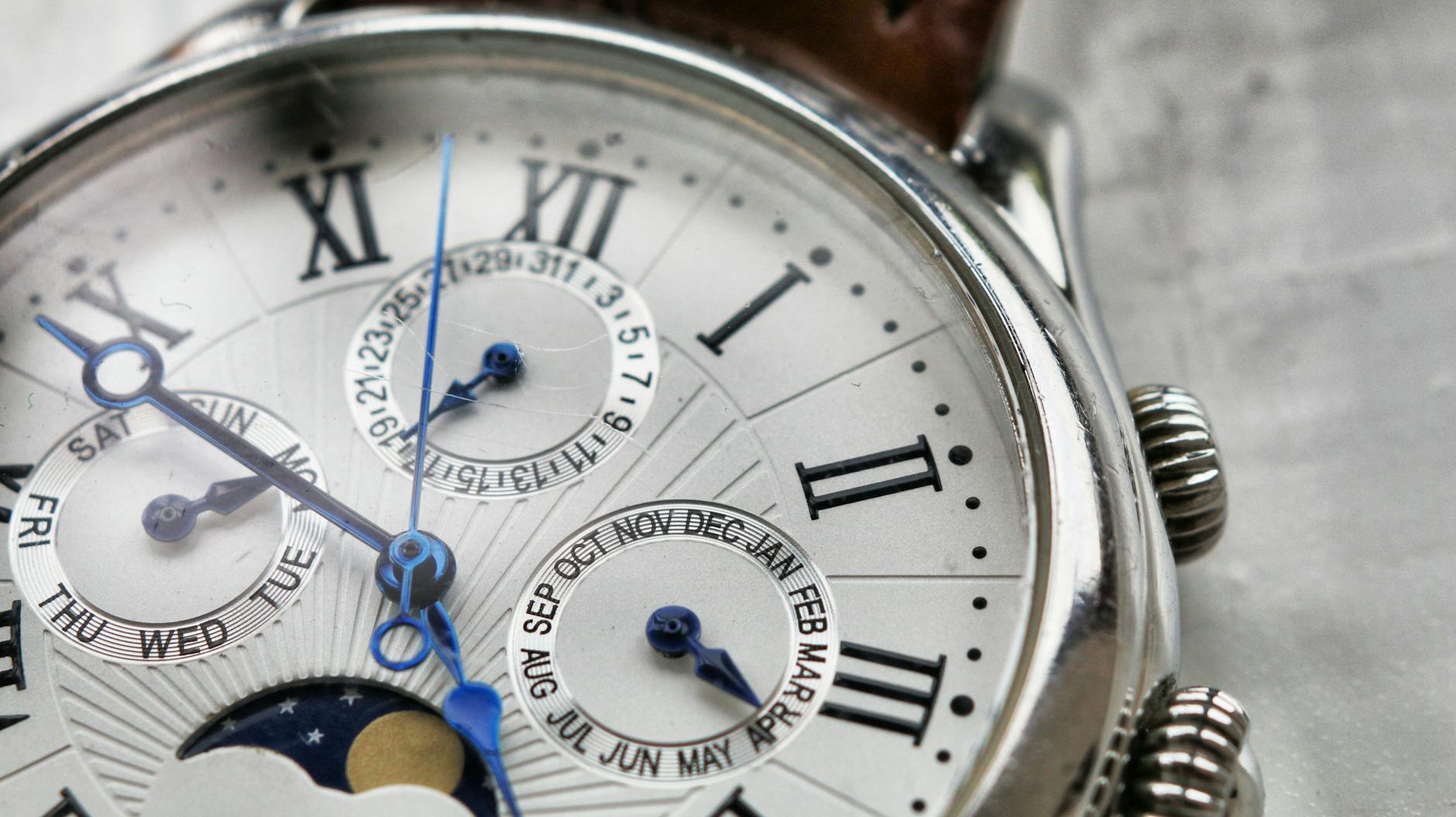
In a mechanical perpetual calendar watch, the central challenge is programming the irregular rhythm of the months into a physical structure. The solution is a cam-and-lever system driven by a specially shaped wheel that completes one full rotation every 48 months, that is, every four years. This 48-month wheel is the physical embodiment of the Gregorian four-year cycle. Its perimeter is shaped with precisely calculated steps and plateaus, each corresponding to the end of a specific month, telling the date mechanism how many days to advance when the month changes.
The cam interacts with a feeler lever, a thin arm that rests against the cam's surface. As the cam rotates, the lever rises and falls according to the cam's profile. At the end of a 31-day month, the lever barely moves; at the end of a 30-day month, it advances the date display by one extra day; at the end of February in a common year, it advances by two extra days; and at the end of February in a leap year, it advances by only one. The entire irregular calendar rhythm is thus encoded in the physical shape of a single rotating disc. It is one of the most elegant examples of analog programming in all of mechanical engineering.
Some high-end movements also incorporate a secular correction mechanism to account for the century leap year exception, a truly rare complication, since it only needs to act once every 100 years. These so-called "secular perpetual calendar" watches are among the most complex mechanical objects ever made. For most purposes, however, the 48-month cam provides sufficient accuracy for any human lifetime, and it is the principle that underlies the logic of decorative desk perpetual calendars as well.
Calendar Mathematics: Modular Arithmetic and the Doomsday Algorithm

The same mathematical structure that drives mechanical perpetual calendars also enables purely computational ones. Modular arithmetic, the mathematics of remainders, is the key tool. When we say the calendar repeats every 400 years and that 400 years contain exactly 146,097 days, and that 146,097 mod 7 = 0, we are using modular arithmetic to prove the cycle. Every calculation a perpetual calendar performs, whether in gears or in code, reduces to finding a remainder when dividing by 7, the number of days in a week.
One of the most celebrated applications of this mathematics is the Doomsday Algorithm, developed by the mathematician John Horton Conway in 1973. The algorithm exploits the fact that certain easy-to-remember dates within any year always fall on the same day of the week, Conway called this day the "Doomsday" for that year. For example, 4/4, 6/6, 8/8, 10/10, and 12/12 always share the same day of the week in any given year. By calculating the Doomsday for a target year using a short sequence of modular arithmetic steps, one can determine the day of the week for any date in that year within seconds. This is precisely the logic a printed or digital perpetual calendar encodes in its lookup tables and rotating discs.
For those who enjoy the intersection of mathematics and everyday objects, this is where calendar science becomes genuinely exciting. A beautifully designed desk perpetual calendar is not merely an organizer, it is a physical implementation of modular arithmetic, a tangible proof that the universe's irregular rhythms can be tamed by human ingenuity. We invite you to explore our mathematical decor collection for objects that celebrate exactly this kind of intellectual beauty.
The Desk Perpetual Calendar as a Scientific Decorative Object

There is something deeply satisfying about a well-made desk perpetual calendar. Unlike a digital clock that silently updates itself in the background, a physical perpetual calendar invites a moment of conscious engagement, the small, deliberate act of advancing the date each morning, a ritual that connects the user to the underlying science of timekeeping. The best desk perpetual calendars are designed as objects worthy of display, crafted from materials such as solid wood, brushed aluminum, or polished concrete, with typography and proportions that make them as pleasing to the eye as they are useful.
From a decorative standpoint, a perpetual calendar occupies a unique position among scientific desk objects. It belongs to the same family of instruments as the solid oak perpetual desk calendar, objects that reward the curious observer with layers of meaning. Where a Newton's Cradle demonstrates conservation of momentum and a Galileo thermometer reveals the physics of buoyancy, a perpetual calendar makes visible the deep mathematical structure of time itself. It is a conversation piece that carries genuine intellectual weight.
For anyone furnishing a home office, a study, or a professional workspace with objects that reflect a love of science, a perpetual calendar is an essential piece. It pairs naturally with other instruments of measurement and observation, and it serves as a daily reminder that the world around us, even something as mundane as the date, is governed by beautiful, discoverable rules. We are proud to offer a curated selection in our perpetual calendar collection, where craftsmanship and scientific heritage meet in objects designed to last a lifetime.
Conclusion
From the astronomical ambitions of ancient Greek engineers to the cam-and-lever ingenuity of 18th-century watchmakers, and from the modular arithmetic of the Doomsday Algorithm to the quiet elegance of a wooden desk calendar, the perpetual calendar is one of humanity's most enduring scientific achievements. It is proof that even the irregular, imperfect rhythms of the cosmos can be captured in a system of rules elegant enough to fit in the palm of your hand. The next time you advance your desk calendar to a new day, take a moment to appreciate the centuries of mathematics and craftsmanship that make that simple gesture possible. If you are ready to bring a piece of that history to your own workspace, explore our full collection and find the perpetual calendar that speaks to your sense of scientific wonder.



Leave a comment
All comments are moderated before being published.
This site is protected by hCaptcha and the hCaptcha Privacy Policy and Terms of Service apply.