

Conservation of Energy: Why Does Newton's Cradle Keep Swinging?
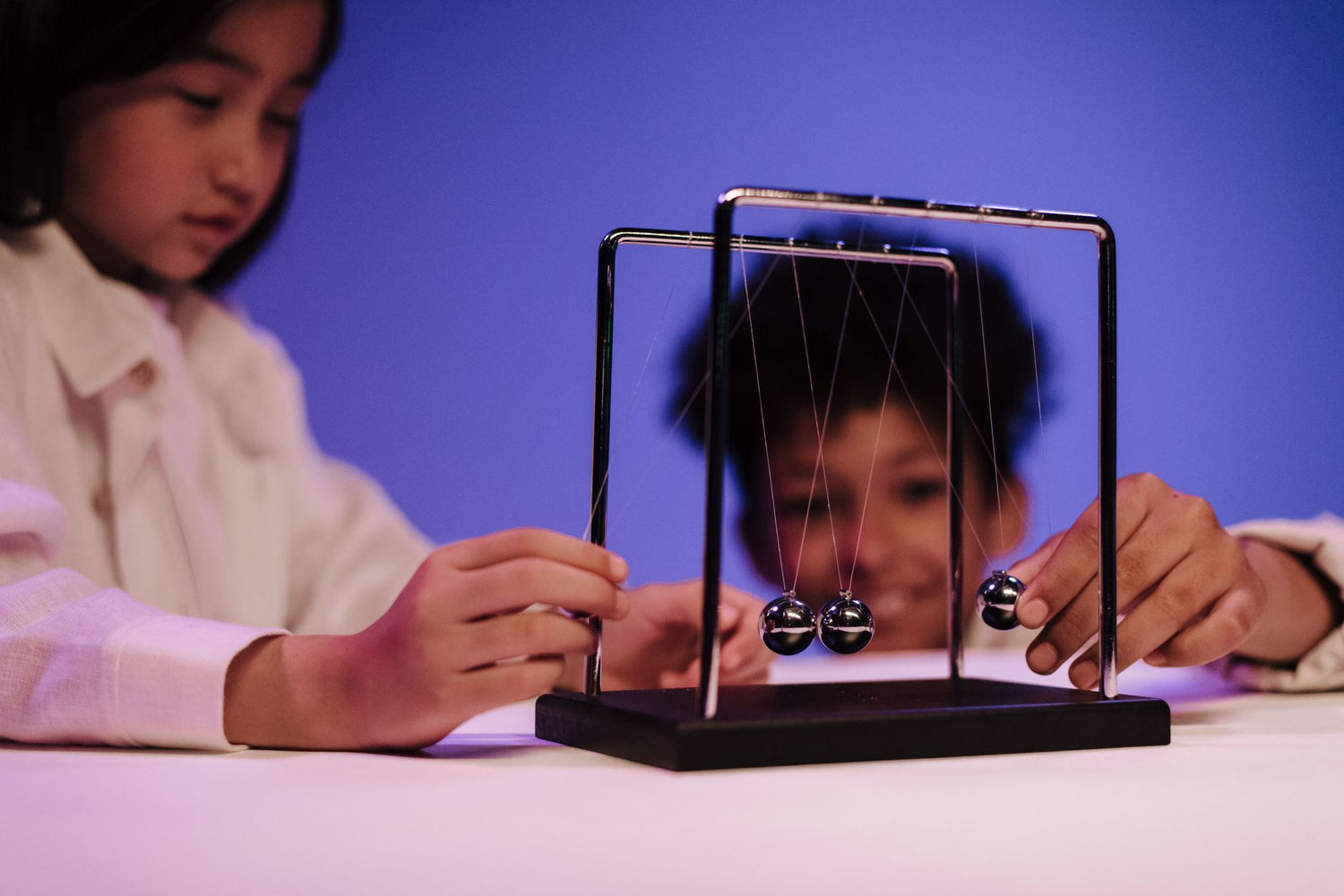
Few objects capture the elegance of physics quite like a Newton's cradle pendulum sitting on a desk, its steel balls swinging back and forth in a hypnotic, seemingly endless rhythm. Watch it long enough, and you might start to wonder: where does all that energy go, and why does it eventually stop? The answer lies in one of the most fundamental laws of the universe, the conservation of energy. In this article, we explore exactly what is happening inside that deceptively simple device, from the first swing to the very last.
What Is the Law of Conservation of Energy?
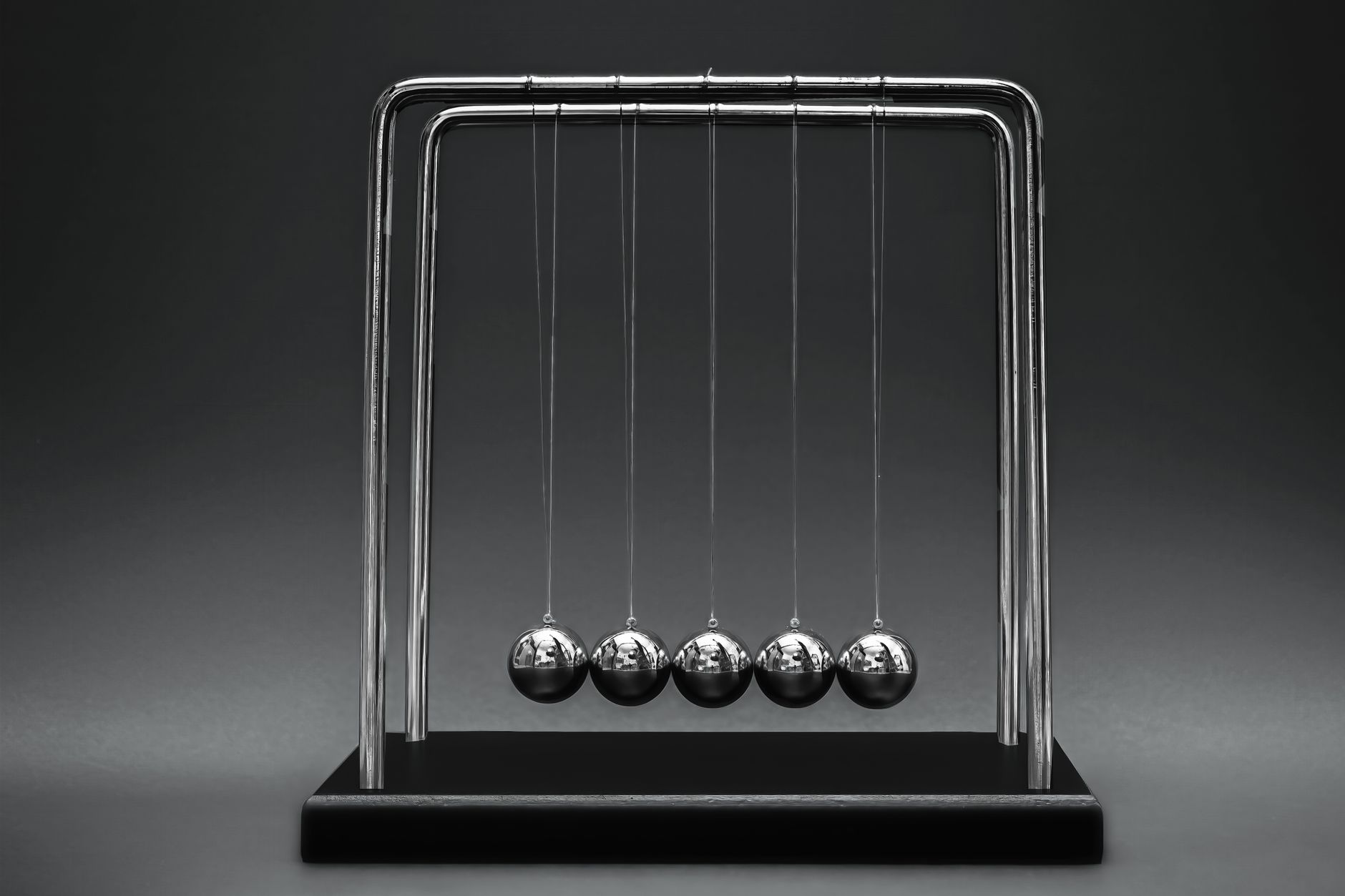
The law of conservation of energy states that energy cannot be created or destroyed, it can only be transformed from one form into another. This principle is one of the cornerstones of classical physics, first formalized in the nineteenth century and confirmed countless times through experiment. Whether you are talking about a rolling ball, a burning candle, or a swinging pendulum, the total amount of energy in a closed system always remains constant.
In practical terms, this means that every time you observe motion, heat, light, or sound, you are witnessing energy changing form rather than appearing from nowhere. Conservation of energy physics applies universally, from subatomic particles to planetary orbits. The Newton's cradle pendulum is a beautiful, desk-sized demonstration of this law in action, making an abstract concept tangible and visible to anyone who picks one up.
What makes the Newton's cradle particularly compelling is that it demonstrates energy transfer in a way that feels almost magical. When one ball is lifted and released, it strikes the others and the energy travels through the chain of steel spheres almost instantaneously, launching the ball on the opposite end into the air. No energy is conjured; it is simply redirected. Understanding this process is the key to understanding why the device behaves exactly as it does.
Kinetic Energy and Potential Energy: The Two Stars of the Show

To understand the Newton's cradle, one must first grasp the difference between kinetic energy and potential energy. Kinetic energy is the energy of motion, any object that is moving possesses it, and its magnitude depends on the object's mass and speed. Potential energy, on the other hand, is stored energy that results from an object's position relative to a reference point, such as the ground.
When you lift one of the balls on a Newton's cradle to the side, you are doing work against gravity. That work is stored as gravitational potential energy in the raised ball. The moment you release it, gravity pulls the ball downward, and that stored potential energy begins converting into kinetic energy. By the time the ball reaches the bottom of its arc, the lowest point of the swing, nearly all of its potential energy has been converted into kinetic energy, and the ball is moving at its maximum speed.
This interplay between kinetic and potential energy in a pendulum is continuous and rhythmic. As the ball rises on the other side after a collision, kinetic energy converts back into potential energy. The cycle repeats with each swing, creating the mesmerizing back-and-forth motion we associate with pendulums. The Newton's cradle simply adds the extra dimension of multiple balls and energy transfer between them, making the physics even richer and more visually satisfying.
How Newton's Cradle Transfers Energy Between the Balls

Newton's cradle energy transfer occurs through a process known as elastic collision. When the swinging ball strikes the row of stationary balls, it transfers its kinetic energy through the chain of steel spheres almost without loss. The balls in the middle barely move at all, they act as conductors of the energy wave, while the ball on the opposite end receives the transferred energy and flies outward.
This behavior is governed by two conservation laws working simultaneously: the conservation of energy and the conservation of momentum. Both quantities must be preserved in a perfectly elastic collision, and it is the combination of these two constraints that forces exactly one ball to rise on the other side when one ball is dropped, two balls when two are dropped, and so on. The mathematics leaves no other option.
It is worth noting that the speed at which energy travels through the steel balls is remarkably fast, essentially at the speed of sound through steel, which is approximately 5,100 meters per second. This is why the middle balls appear not to move; the energy pulse passes through them so quickly that the human eye cannot detect the tiny compression waves. What looks like a simple toy is, in reality, a precision demonstration of wave mechanics and collision physics happening at extraordinary speed.
Why Does Newton's Cradle Eventually Stop? Energy Lost to Sound and Heat

If energy is truly conserved, why does the Newton's ball swing gradually slow down and eventually come to rest? The answer is that the system is not perfectly isolated. In the real world, energy is continuously leaking out of the cradle in forms that are not useful for keeping the balls moving. The most obvious of these is sound, that characteristic clicking noise you hear with each collision is energy escaping the system as acoustic vibration.
Heat is another major culprit. Each time the steel balls collide, the tiny deformations at the point of contact generate thermal energy through internal friction within the metal. Air resistance also plays a role: as the balls swing through the air, they must push air molecules out of the way, transferring some of their kinetic energy to the surrounding atmosphere. None of this energy is destroyed, it is simply dispersed into the environment in forms that cannot drive the pendulum further.
The strings themselves also absorb a small amount of energy through vibration and slight flexing with each swing. All of these losses, though individually small, accumulate over time. The result is that the amplitude of each swing decreases gradually until the balls come to rest at the bottom. This is not a failure of the conservation of energy, it is a perfect illustration of it. The energy did not vanish; it was simply redistributed into sound, heat, and air movement throughout the room.
Perfectly Elastic Collisions: Theory Versus Reality

In physics textbooks, the Newton's cradle is often described as a system of perfectly elastic collisions, collisions in which kinetic energy is completely conserved and no energy is lost to deformation, heat, or sound. In a perfectly elastic collision, the objects involved bounce off each other without any permanent change in shape, and the total kinetic energy before and after the collision is identical. This is a useful theoretical model, but it is an idealization.
Real steel balls are not perfectly elastic. When they collide, microscopic deformations occur at the contact point, generating heat and sound as we discussed above. The collisions in a Newton's cradle are nearly elastic but not perfectly so, which is precisely why the device eventually stops. The closer the balls are to being perfectly rigid and smooth, the longer the cradle will swing, which is why high-quality Newton's cradles use hardened steel balls polished to a fine finish.
Understanding the gap between theoretical models and real-world behavior is one of the most important lessons physics has to offer. A perfect Newton's cradle would swing forever in a vacuum, with no air resistance and no energy losses. The fact that real ones do not is not a flaw, it is an invitation to think more deeply about the hidden forces at work. This is the kind of nuanced thinking that transforms a desk ornament into a genuine scientific instrument.
Newton's Cradle as a Tool for Learning and Inspiration

Beyond its scientific value, the Newton's cradle pendulum has become a beloved symbol of intellectual curiosity and scientific elegance. It sits on the desks of scientists, engineers, teachers, and thinkers around the world, not just as a toy, but as a constant, gentle reminder that the universe operates according to beautiful, discoverable rules. Every swing is a small lecture in physics, delivered without words.
For those who enjoy surrounding themselves with objects that carry scientific meaning, a Newton's cradle is an ideal starting point. We invite you to explore our collection of Newton's cradles, where you will find models ranging from elegant desktop classics to larger statement pieces designed to spark conversation and curiosity. Each one is a working demonstration of the principles we have explored in this article, ready to sit on your desk and swing indefinitely, or at least until friction has its say.
If you are drawn to the broader world of physics-inspired decor, you will find much to appreciate in our physical sciences ambiance collection, which brings together objects that celebrate the laws governing motion, energy, and matter. For those who want something truly special, we also recommend our executive chrome five-ball Newton's cradle, a premium piece crafted for those who appreciate both scientific accuracy and refined aesthetics. Science has never looked quite so good on a desk.
Conclusion: The Universe's Most Elegant Bookkeeper

The law of conservation of energy is one of nature's most reliable accountants, it tracks every joule of energy through every transformation, ensuring that nothing is ever truly lost. The Newton's cradle pendulum puts this principle on full display, converting potential energy into kinetic energy, transferring it through steel balls at the speed of sound, and slowly surrendering it to heat and sound until the last swing fades. It is, in miniature, a portrait of how the universe manages its resources.
We hope this exploration of Newton's cradle energy transfer and conservation of energy physics has given you a deeper appreciation for what is happening every time those silver balls begin to swing. The next time you pull one back and let it go, you will not just see a toy, you will see thermodynamics, wave mechanics, and classical physics playing out in perfect harmony. That is the true beauty of a great scientific instrument: it makes the invisible visible.
If this article has sparked your curiosity, we encourage you to browse our full range of scientific decor and discover more objects that bring the laws of nature to life in your home or office. Science is everywhere, and it has never been more beautiful.



Leave a comment
All comments are moderated before being published.
This site is protected by hCaptcha and the hCaptcha Privacy Policy and Terms of Service apply.