

How Does a Drinking Bird Work? Thermodynamics Explained
Few objects on a desk inspire as much curiosity as the classic Drinking Bird, that mesmerizing, top-hatted toy that bobs its beak into a glass of water with hypnotic regularity, seemingly forever. At first glance, it appears to be a perpetual motion machine, defying the very laws of physics. In reality, it is something far more fascinating: a beautifully engineered heat engine that demonstrates some of the most fundamental principles of thermodynamics. Understanding how this toy works is a journey through evaporative cooling, vapor pressure, and phase changes that will forever change the way you look at your desk.
A Brief History of the Drinking Bird Toy

The Drinking Bird, sometimes affectionately called the "Dippy Bird," has a history that stretches back further than most people realize. Its origins are widely believed to trace back to China, where similar novelty devices were crafted long before the toy became a Western sensation. The version most familiar to American audiences was patented in the United States in 1945 by Miles V. Sullivan, an inventor working with the American company Miles Novelty. Sullivan's design refined the toy into the elegant, glass-tube form we recognize today.
The toy's reputation received an extraordinary boost when none other than Albert Einstein reportedly became captivated by it. According to accounts from his colleagues, Einstein spent considerable time studying the Drinking Bird, initially puzzled by its seemingly effortless motion. When he finally worked out the thermodynamic principles at play, he is said to have been genuinely delighted, a fitting tribute to a toy that operates on real, elegant science. This story, whether entirely accurate or partly apocryphal, speaks to the toy's power to engage even the greatest scientific minds.
Decades later, the Drinking Bird has transcended its novelty origins to become one of the most beloved scientific desk toys for adults and science enthusiasts alike. It has appeared in university physics courses, science museums, and even in popular television shows as a symbol of clever, self-sustaining ingenuity. Its enduring appeal lies precisely in the fact that it is not magic, it is physics made visible, elegant, and endlessly watchable.
The Anatomy of a Drinking Bird

Before diving into the thermodynamics, it is worth understanding what the Drinking Bird is actually made of. The toy consists of two glass bulbs connected by a long glass tube, all mounted on a pivot point that allows the entire assembly to tilt forward and back. The lower bulb serves as a reservoir, while the upper bulb forms the bird's head, typically covered with a felt-like material that absorbs water. A colorful plastic beak and a jaunty top hat complete the whimsical aesthetic.
Inside the sealed glass system lives the real secret: a volatile liquid, most commonly methylene chloride (dichloromethane), which has an exceptionally low boiling point of around 104°F (40°C). This liquid is present in both bulbs, and the space above it is filled with the vapor of the same chemical. The entire system is sealed and contains no external power source, no batteries, no motors, no hidden mechanisms. Everything that makes the bird move comes from the interaction between this volatile fluid and the surrounding environment.
The pivot point is carefully positioned so that the bird is slightly top-heavy when its head is wet, but bottom-heavy when it is dry and upright. This precise mechanical balance is not accidental, it is an essential part of the thermodynamic cycle that drives the bird's motion. Every element of the design, from the felt covering to the length of the glass tube, has been engineered to maximize the efficiency of the heat exchange process taking place inside.
Evaporative Cooling: The Engine's Cold Side
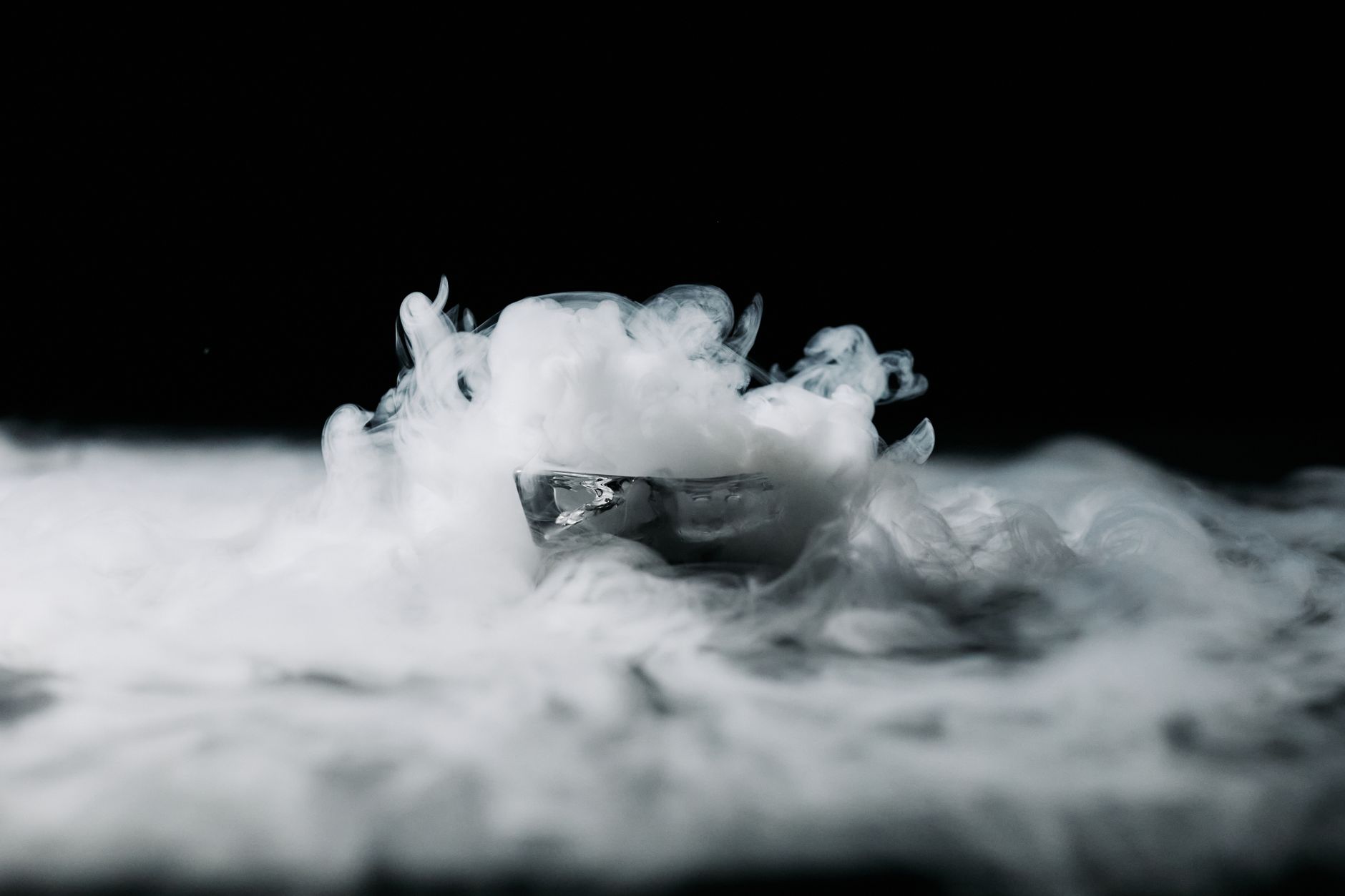
The Drinking Bird's cycle begins the moment its felt-covered beak dips into a glass of water. Evaporative cooling is the fundamental process that initiates everything. When the wet felt on the bird's head is exposed to the surrounding air, water molecules at the surface absorb energy from their environment and escape into the atmosphere as vapor. This process removes thermal energy from the felt and, crucially, from the glass head beneath it, causing the temperature of the upper bulb to drop noticeably below that of the lower bulb.
This temperature differential, even just a few degrees Celsius, is the key to the entire mechanism. The upper bulb becomes the "cold reservoir" of the heat engine, while the warmer ambient air surrounding the lower bulb acts as the "hot reservoir." In thermodynamic terms, a heat engine requires exactly this kind of temperature gradient to do work, and the Drinking Bird exploits it with remarkable elegance. The greater the rate of evaporation from the head, the steeper the temperature difference, and the more vigorously the bird will bob.
This is why the bird works better on warm, dry days than on cool, humid ones. Low humidity accelerates evaporation, creating a larger temperature gradient and driving the cycle faster. On a very humid day, when the air is already saturated with water vapor, evaporation from the felt slows dramatically, and the bird may barely move at all. This sensitivity to environmental conditions is itself a beautiful demonstration of real-world thermodynamics in action, the toy is, in a sense, reading the weather.
Vapor Pressure and the Rise of the Fluid

Once the upper bulb cools down, something remarkable happens inside the sealed glass system. The volatile liquid inside the toy exerts a vapor pressure that is highly sensitive to temperature. When the upper bulb is cooler than the lower bulb, the vapor pressure in the head drops relative to the pressure in the warmer lower bulb. This pressure difference acts like a pump, pushing the liquid methylene chloride up through the narrow connecting tube from the lower reservoir toward the upper bulb.
As the liquid rises through the tube, the center of gravity of the entire bird shifts upward and toward the head. The bird begins to tilt forward, leaning its beak toward the glass of water. This is not a gradual, imperceptible shift, it is a visible, measurable redistribution of mass driven entirely by the physics of vapor pressure. The longer the tube and the greater the pressure differential, the more dramatically the fluid rises and the more decisively the bird tilts.
This phase of the cycle is a perfect illustration of how pressure gradients can perform mechanical work. The system is converting a temperature difference into a pressure difference, and that pressure difference into physical movement, a chain of energy transformations that mirrors the operation of far larger heat engines, from steam turbines to refrigerators. The Drinking Bird makes these abstract concepts tangible and visible in a way that textbooks alone rarely achieve. For those who appreciate the physics of such elegant systems, exploring our collection of Stirling engines offers another stunning example of a heat engine you can watch in action on your desk.
The Dip, the Reset, and the Continuous Cycle

When enough liquid has traveled up the tube and the bird's center of gravity has shifted sufficiently forward, the bird tips all the way down, dunking its beak into the water. This dipping action is the dramatic payoff of the entire thermodynamic buildup. As the beak touches the water, the felt absorbs a fresh supply of liquid, re-wetting the head and setting the stage for the next cycle of evaporative cooling. Simultaneously, the tilting action opens the bottom of the glass tube, allowing vapor to bubble up from the lower bulb through the liquid column.
This vapor transfer rapidly equalizes the pressure between the two bulbs, causing the liquid to flow back down to the lower reservoir under gravity. The bird swings back upright, its lower bulb once again full of liquid and its head freshly wet with water. The temperature differential begins to re-establish itself as evaporation resumes from the damp felt, and the entire cycle starts over. The process repeats with remarkable consistency, limited only by the supply of water in the glass and the rate of evaporation from the head.
What makes this cycle so compelling is that no energy is created from nothing. The bird is continuously harvesting thermal energy from the environment, specifically from the heat content of the surrounding air and the water in the glass, and converting a tiny fraction of it into mechanical work (the bobbing motion). The rest is dissipated as the evaporated water carries energy away into the atmosphere. This is entirely consistent with the laws of thermodynamics, and it is precisely why the Drinking Bird is not a perpetual motion machine, despite appearances. If you are drawn to the intersection of physics and beautiful design, our physical science collection showcases a curated range of objects that bring these principles to life.
The Drinking Bird as a True Heat Engine

Physicists and engineers classify the Drinking Bird as a genuine heat engine, and this classification is not merely metaphorical. A heat engine is any device that converts thermal energy into mechanical work by exploiting a temperature difference between a hot and a cold reservoir. The Drinking Bird does exactly this: it uses the warm ambient air as its hot reservoir and the evaporatively cooled head as its cold reservoir, extracting work in the form of the repetitive bobbing motion. This places it in the same conceptual category as a steam engine or an internal combustion engine, just at a far more intimate scale.
The theoretical upper limit of efficiency for any heat engine operating between two temperature reservoirs is defined by the Carnot cycle, named after the French physicist Sadi Carnot. The Carnot efficiency depends entirely on the temperatures of the hot and cold reservoirs, the greater the difference, the higher the potential efficiency. The Drinking Bird operates with a very small temperature differential (often just 2–5°C between the head and the lower bulb), which means its Carnot efficiency is quite low. In practice, it converts only a minuscule fraction of the available thermal energy into mechanical motion, with the vast majority lost to the environment.
Nevertheless, the Drinking Bird's status as a heat engine makes it an extraordinary teaching tool. It demonstrates the Zeroth, First, and Second Laws of Thermodynamics simultaneously: thermal equilibrium drives the system, energy is conserved throughout the cycle, and entropy always increases as heat flows from hot to cold. Few objects illustrate these abstract principles as vividly and accessibly as this small, charming toy. For a complementary scientific desk piece that similarly transforms invisible physical forces into visible, mesmerizing motion, we recommend our classic Drinking Bird heat engine, a timeless addition to any science enthusiast's workspace.
Why the Drinking Bird Remains a Beloved Scientific Desk Toy

In an age of digital screens and virtual simulations, the Drinking Bird endures because it offers something that no app or animation can replicate: real physics, unfolding in real time, right in front of your eyes. There is a profound satisfaction in watching a toy that operates on the same thermodynamic principles as a power plant, doing so without a single battery or line of code. It invites questions, sparks conversations, and rewards careful observation, all qualities that make it ideal for desks, classrooms, and living rooms alike.
The toy also serves as a gateway to deeper scientific curiosity. Many people who encounter a Drinking Bird for the first time find themselves drawn into reading about evaporative cooling, vapor pressure, and the Carnot cycle, concepts they might never have explored otherwise. In this sense, the Drinking Bird is not just a decoration; it is a scientific instrument for inspiring wonder. It belongs to a proud tradition of elegant, self-contained demonstrations that make abstract science concrete and approachable, from Newton's Cradle to the Galileo Thermometer.
Whether you are a physics teacher looking for a classroom demonstration, a science enthusiast furnishing your home office, or simply someone who appreciates the beauty of a well-designed object, the Drinking Bird has something to offer. It is a reminder that some of the most profound ideas in science can be held in the palm of your hand, observed with the naked eye, and understood without a single equation, though the equations, when you are ready for them, are just as beautiful as the toy itself.
Conclusion
The Drinking Bird is far more than a novelty item, it is a window into the elegant machinery of thermodynamics, a physical demonstration of heat engines, evaporative cooling, and vapor pressure that has captivated scientists and curious minds for nearly a century. From its origins in China to Albert Einstein's reported fascination, and from the university physics lab to the modern office desk, this remarkable toy has earned its place in the pantheon of great scientific demonstrations. It proves, beautifully and repeatedly, that the laws of physics are not dry abstractions but living principles that shape the world around us every moment of every day. If the Drinking Bird has sparked your curiosity, we invite you to explore our full range of scientific desk toys and decorations, because science, when you can see it, touch it, and watch it work, is one of life's greatest pleasures.

Leave a comment
All comments are moderated before being published.
This site is protected by hCaptcha and the hCaptcha Privacy Policy and Terms of Service apply.