

How Does a Fidget Spinner Work? The Physics Explained
Pick up a desk fidget spinner, give it a flick, and watch it hum for minutes on end, it seems almost magical. Yet every second of that smooth, silent spin is governed by some of the most elegant laws in classical physics. Far from being a mere distraction, the fidget spinner is a miniature physics laboratory that fits in the palm of your hand. In this article, we break down exactly what is happening inside that spinning disc and why understanding it will make you appreciate your desk toy on a whole new level.
What Is a Desk Fidget Spinner, Really?

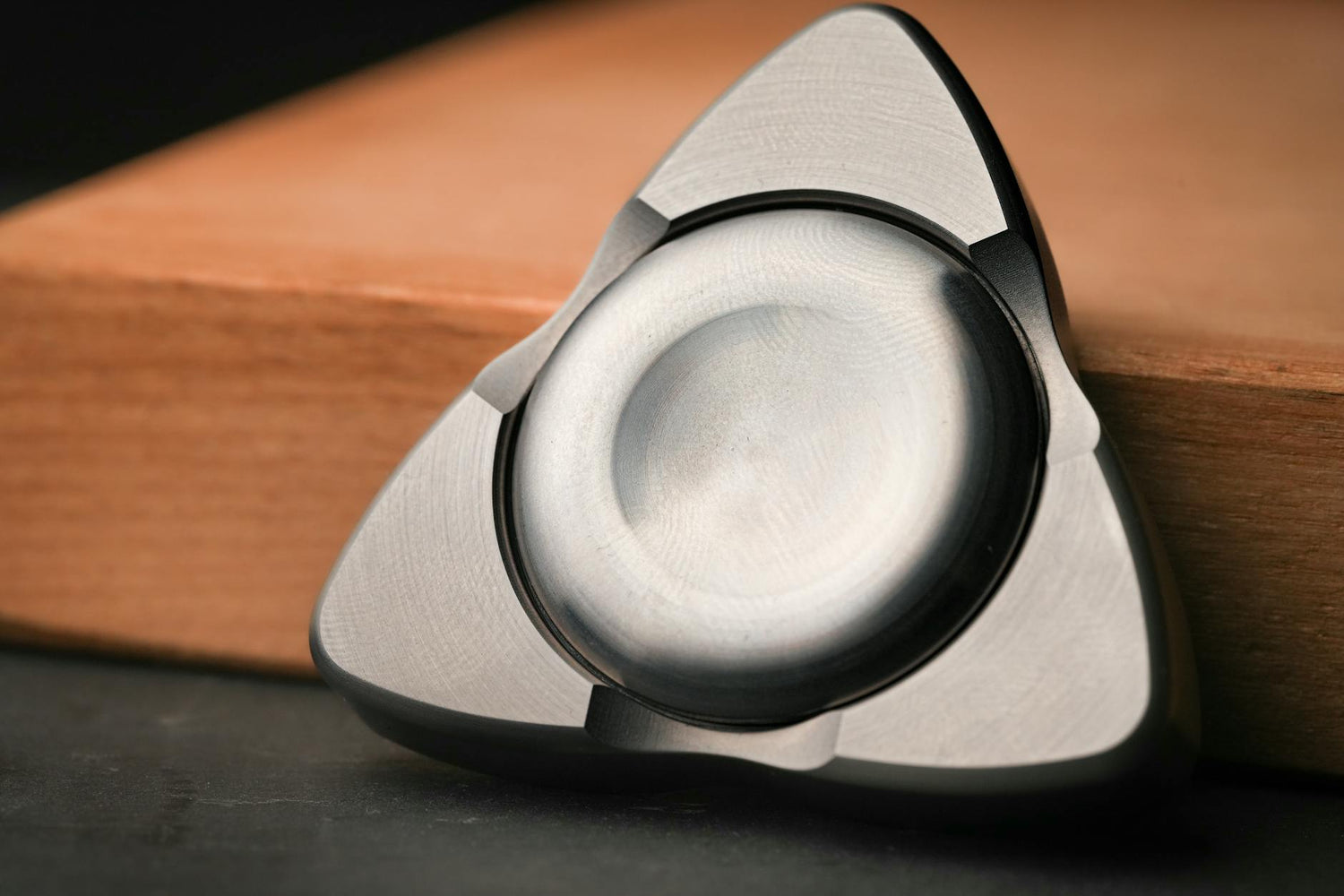
At its most basic level, a desk fidget spinner is a flat, multi-lobed frame made from plastic, brass, stainless steel, or titanium, with a central bearing that allows it to rotate freely around a fixed axis. The user holds the center cap between two fingers, flicks one of the outer lobes, and the body of the spinner rotates around the stationary hub. That seemingly simple design is actually a carefully engineered system built to minimize energy loss while maximizing rotational inertia.
The weight distribution of the spinner matters enormously. Most high-quality desk spinners concentrate mass in the outer lobes, as far from the center as possible. This is not an accident or a stylistic choice, it is a deliberate application of rotational physics. The further the mass sits from the rotation axis, the harder it is to stop the object once it is spinning, which is precisely what makes a good desk fidget toy so satisfying to use.
Desk fidget toys come in dozens of shapes, tri-spinners, bi-bars, quads, and more exotic geometries, but they all share the same core mechanical principle. The shape determines the moment of inertia, the bearing determines friction losses, and together these two factors determine how long and how smoothly your spinner will rotate. Understanding these two elements is the key to understanding the entire device.
The Unsung Hero: Ball Bearings and Friction Reduction

The central bearing is the heart of every desk spinner, and it is worth spending a moment understanding what it actually does. A standard fidget spinner bearing consists of an inner race, an outer race, and a set of small steel balls rolling between them. When you hold the inner race still and spin the outer frame, those balls roll rather than slide, which is the critical distinction. Rolling friction is dramatically lower than sliding friction, which is why a well-made bearing can allow thousands of rotations before the spinner comes to rest.
The quality of the bearing directly determines the spin time of the device. Premium spinners use ABEC-7 or ABEC-9 rated bearings, which are manufactured to extremely tight tolerances. The smoother the contact surfaces and the more precisely the balls are sized, the less energy is lost to heat with each revolution. Some enthusiasts remove the rubber shields from their bearings and clean out the factory grease entirely, replacing it with a thin oil or nothing at all, because even lubricant introduces a small but measurable drag force.
It is also worth noting that the material of the balls themselves plays a role. Ceramic ball bearings, made from silicon nitride, are harder, lighter, and smoother than steel equivalents, which is why they are found in the most coveted high-performance desk fidget spinners. The physics principle at work here is simple: every source of friction converts kinetic energy into heat, and heat is energy that can never be recovered to keep the spinner turning. Minimizing friction is therefore the single most important engineering goal in spinner design.
Angular Momentum: Why the Spinner Keeps Spinning

Once the bearing friction is addressed, the next question is: why does the spinner keep going at all? The answer lies in one of the most fundamental concepts in classical mechanics, angular momentum. Angular momentum is the rotational equivalent of linear momentum, and just as a moving car tends to keep moving unless a force acts on it, a spinning object tends to keep spinning unless a torque acts on it. This principle is known as the conservation of angular momentum.
Angular momentum (L) is defined mathematically as the product of the moment of inertia (I) and the angular velocity (ω), expressed as L = Iω. The moment of inertia is essentially a measure of how difficult it is to change an object's rotational state, and it depends both on the total mass of the object and on how that mass is distributed relative to the axis of rotation. This is exactly why spinner designers place heavy lobes far from the center: a larger moment of inertia means more angular momentum for the same spin speed, which in turn means the spinner resists slowing down more effectively.
In the absence of external torques, angular momentum is perfectly conserved. In the real world, the bearing and air resistance apply small but continuous opposing torques, gradually bleeding away the spinner's angular momentum. The slower it spins, the less angular momentum it possesses, and eventually the friction torque is enough to bring it to a stop. A heavier, more spread-out spinner has more angular momentum to lose, which is why it outlasts a lighter, more compact design even when both are spun at the same initial speed.
Gyroscopic Precession: The Wobble That Defies Intuition

Here is where fidget spinner physics becomes genuinely surprising. If you balance a spinning angular momentum desk toy on one finger while it is rotating at high speed, you will notice that it resists tipping over in a way that a non-spinning object never would. This phenomenon is called gyroscopic precession, and it is one of the most counterintuitive effects in all of classical mechanics.
When an external torque, such as the pull of gravity on a tilted spinner, acts on a rapidly rotating object, the object does not simply fall in the direction of the force. Instead, it responds at a right angle to both the applied torque and its own angular momentum vector. The result is that the spinner's axis slowly rotates, or precesses, around the vertical axis rather than toppling over. The faster the spinner rotates, the more pronounced and stable this gyroscopic effect becomes. This is the same principle that keeps a bicycle upright when moving and guides the trajectory of a thrown football.
Gyroscopic precession is also why fidget spinners feel so peculiar when you try to tilt them while they are spinning at full speed. The device seems to push back against your hand with a force that has no obvious source. That resistance is the angular momentum vector defending its orientation against your applied torque, redirecting the effect into a perpendicular motion instead of a tilt. It is a beautiful, tactile demonstration of a law of physics that most people never encounter outside a textbook.
Exponential Decay: Why Spinning Harder Has Diminishing Returns

Many spinner enthusiasts notice something puzzling: flicking the spinner twice as hard does not make it spin for twice as long. The reason for this lies in the mathematics of exponential decay. The friction torque acting on a spinning object is approximately proportional to the current angular velocity, the faster it spins, the more drag it experiences per unit time. This creates a situation where the spinner loses a fixed percentage of its speed in each successive time interval, rather than a fixed absolute amount.
Mathematically, the angular velocity follows a curve described by ω(t) = ω₀ · e^(−t/τ), where ω₀ is the initial spin speed, t is time, and τ is a time constant determined by the bearing quality and the moment of inertia. Doubling ω₀ only adds one additional time constant's worth of spin time, not double the duration. This is why there is a practical ceiling to how long a spinner can be made to rotate simply by flicking it harder, the returns diminish rapidly as initial speed increases.
This principle has broader implications across physics and engineering. Exponential decay describes radioactive decay, the discharge of a capacitor, and the cooling of a hot object, among many other phenomena. The fidget spinner thus becomes an unexpected entry point into one of the most universally applicable mathematical patterns in all of science. Recognizing this pattern in a desk fidget spinner is a genuine moment of scientific insight available to anyone willing to look carefully.
The Fidget Spinner as a Legitimate Physics Desk Toy

Given everything we have explored, bearing friction, angular momentum, gyroscopic precession, and exponential decay, it becomes clear that the fidget spinner deserves far more intellectual respect than it typically receives. It is not simply a stress-relief gadget; it is a tangible, hands-on demonstration of four distinct principles of classical mechanics, all operating simultaneously in a device small enough to carry in a shirt pocket. In this sense, it belongs in the same category as other beloved desk physics toys.
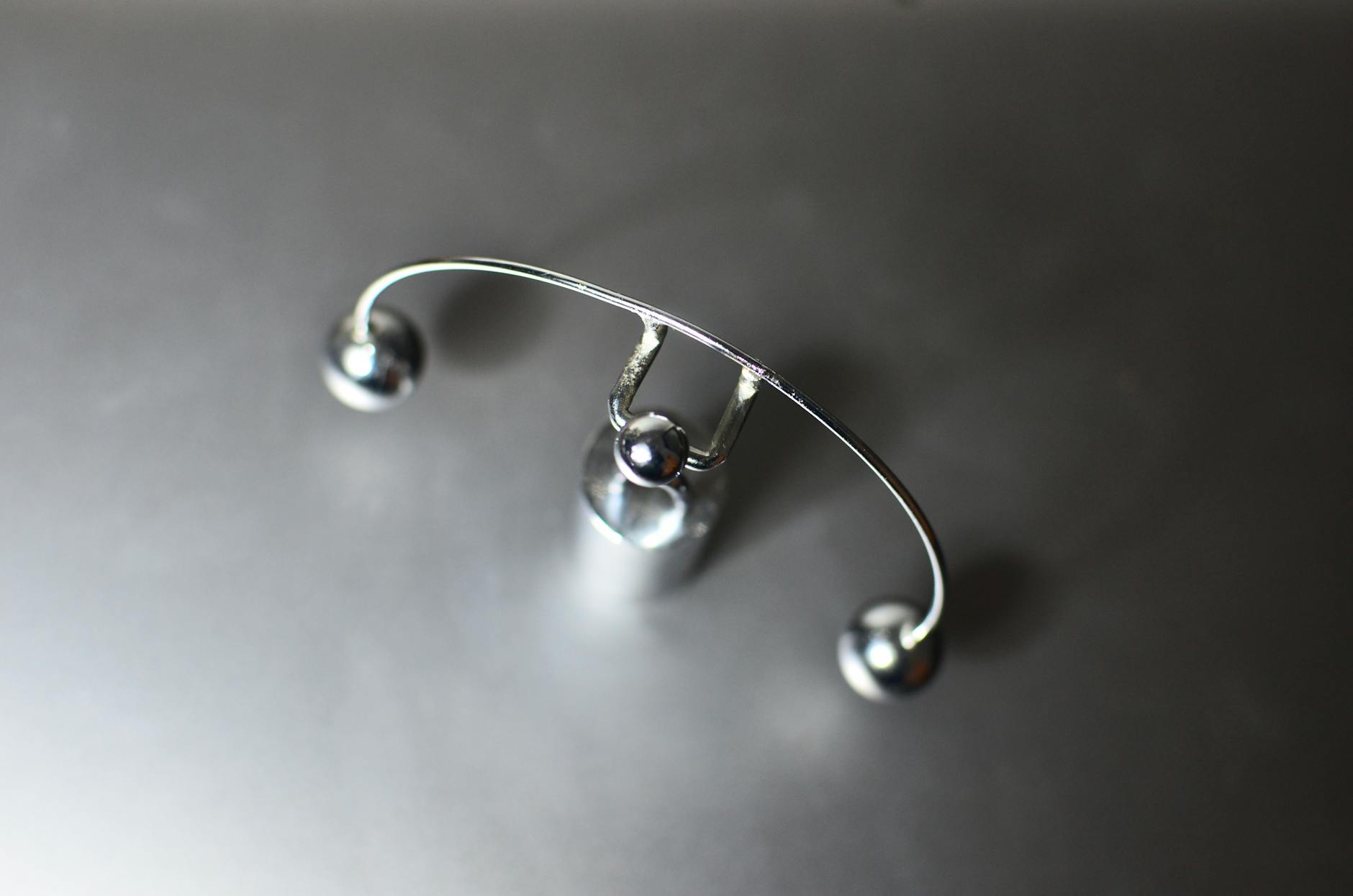
Consider the Newton's Cradle, another iconic desk toy that demonstrates conservation of momentum and energy through the elegant clacking of suspended steel balls. Like the fidget spinner, it transforms abstract physics into something you can see, hear, and feel. If you enjoy the fidget spinner's connection to rotational mechanics, we encourage you to explore our collection of Newton's Cradles, which offer an equally rich demonstration of classical physics in a beautifully crafted desktop format. These objects share the same philosophy: making physics visible, tangible, and present in everyday life.
For those who wish to surround themselves with the broader world of physical science, we also recommend browsing our physical science ambiance collection, which curates objects that celebrate the laws governing motion, energy, and matter. Whether displayed on a desk, a bookshelf, or a laboratory-style workspace, these pieces serve as constant, elegant reminders of the principles that govern our universe. And if you are ready to add a premium spinning experience to your desk, our precision brass tri-spinner fidget is crafted with an ABEC-9 ceramic bearing and solid brass lobes for maximum angular momentum and spin time.
Conclusion
The humble desk fidget spinner is, at its core, a masterclass in classical mechanics, a device that encodes the conservation of angular momentum, the geometry of moment of inertia, the counterintuitive magic of gyroscopic precession, and the mathematics of exponential decay all into a single, elegant object. Understanding these principles does not diminish the pleasure of spinning it; if anything, it deepens the experience by revealing the invisible architecture of physics that makes every rotation possible. We hope this exploration has given you a new appreciation for the science hiding in plain sight on your desk. If you are ready to build a workspace that celebrates scientific curiosity, browse our full desk toys collection and find the perfect physics companion for your everyday environment.


Leave a comment
All comments are moderated before being published.
This site is protected by hCaptcha and the hCaptcha Privacy Policy and Terms of Service apply.