

How Does Newton's Cradle Work? Physics of Pendulum Balls
Few objects on a desk command as much attention, or as many questions, as a desk ball pendulum. You lift one steel ball, release it, and watch as the energy travels invisibly through the motionless middle balls to launch the one on the opposite end. It looks almost magical, yet it is pure, elegant physics. In this article, we unpack the science behind Newton's Cradle, trace its fascinating history, and answer the questions that have puzzled curious minds for decades.
A Brief History of Newton's Cradle

Despite bearing the name of Sir Isaac Newton, the device we know today was not actually invented by him. The foundational experiments date back to the 1660s, when French physicist Edme Mariotte and Dutch polymath Christiaan Huygens independently studied collisions between pendulum balls. Their work demonstrated that both momentum and kinetic energy could be transferred through elastic collisions in ways that were predictable and measurable, a revolutionary insight at the time.
Newton himself cited these experiments in his landmark work Principia Mathematica (1687), which helped cement the principles of motion in scientific history. However, the elegant five-ball desktop version we recognize today was not named "Newton's Cradle" until 1967, when English actor and entrepreneur Simon Prebble coined the term and began selling it as a stylish executive toy. The name stuck, and the device rapidly became a fixture on desks around the world.
By the 1970s, the desk balls pendulum had become a cultural icon of intellectual sophistication. It appeared in boardrooms, university offices, and science classrooms alike. Its rise as a physics desk toy was no accident, it manages to make abstract physical laws instantly visible and tangible, which is a rare and powerful quality in any object.
The Two Laws That Govern Everything

To truly understand Newton's Cradle, one must grasp two fundamental principles of classical physics: conservation of momentum and conservation of kinetic energy. These are not optional guidelines, they are laws of nature, and Newton's Cradle obeys both simultaneously. Together, they dictate exactly how many balls swing out on the opposite side and at what speed.
Conservation of momentum states that the total momentum of a closed system remains constant unless acted upon by an external force. Momentum is calculated as mass multiplied by velocity (p = mv). When one ball strikes the stationary group, the total momentum before the collision must equal the total momentum after it. This is why one ball in means one ball out, the numbers simply must balance.
Conservation of kinetic energy applies specifically to elastic collisions, which are collisions where no energy is lost to heat, sound, or deformation. In an ideal Newton's Cradle, the collisions between the steel balls are very nearly elastic. Kinetic energy is calculated as one-half times mass times velocity squared (KE = ½mv²). Both laws working in tandem produce the mesmerizing, symmetrical behavior that makes this toy so compelling as a Newton's Cradle desk ornament.
Why Don't the Middle Balls Move?

This is perhaps the most common question people ask when they first encounter a desk ball pendulum. If energy is traveling through the device, why do the three middle balls appear completely stationary? The answer lies in how compression waves travel through solids. When the first ball strikes the group, it sends a longitudinal pressure wave, similar to a sound wave, through each successive ball at the speed of sound in steel.
Each ball in the middle acts as a temporary intermediary, briefly compressing and then releasing its neighbor in a chain reaction that happens far too quickly for the human eye to detect. The energy passes through rather than accumulating in any single ball. This is only possible because the balls are in direct contact with one another and are made of a material with a very high elastic modulus, meaning they deform very little under impact.
It is worth noting that the middle balls do move, just imperceptibly. High-speed camera footage has confirmed that each ball in the chain shifts by a tiny fraction of a millimeter during the collision. The apparent stillness of the middle balls is an illusion born from the extreme speed of the wave transmission, not from the balls being truly motionless. This subtlety makes Newton's Cradle even more fascinating from a physics standpoint.
What Happens When You Release Two or More Balls?

Once you understand the one-ball scenario, the logical next question is: what happens when you pull back and release two balls at once? The answer is beautifully consistent with the same laws. If you release two balls on the left, two balls swing out on the right. Release three, and three swing out. The system always finds the unique solution that satisfies both conservation of momentum and conservation of kinetic energy at the same time.
This consistency is not trivial. Mathematically, there are other combinations of balls and velocities that would satisfy conservation of momentum alone, for example, all five balls moving slowly to the right. But those alternatives would violate conservation of kinetic energy, so nature rules them out. The two laws together produce a single, definitive outcome, which is why the cradle behaves so predictably and reliably every time.
Interestingly, if you release two balls on one side and one ball on the other simultaneously, the behavior becomes more complex and less symmetrical. The system still obeys both conservation laws, but the resulting motion involves balls swinging at different heights and different phases. These asymmetric configurations are a wonderful way to explore the deeper nuances of Newton's Cradle physics and are well worth experimenting with on your own desk.
Why Does Newton's Cradle Eventually Stop?
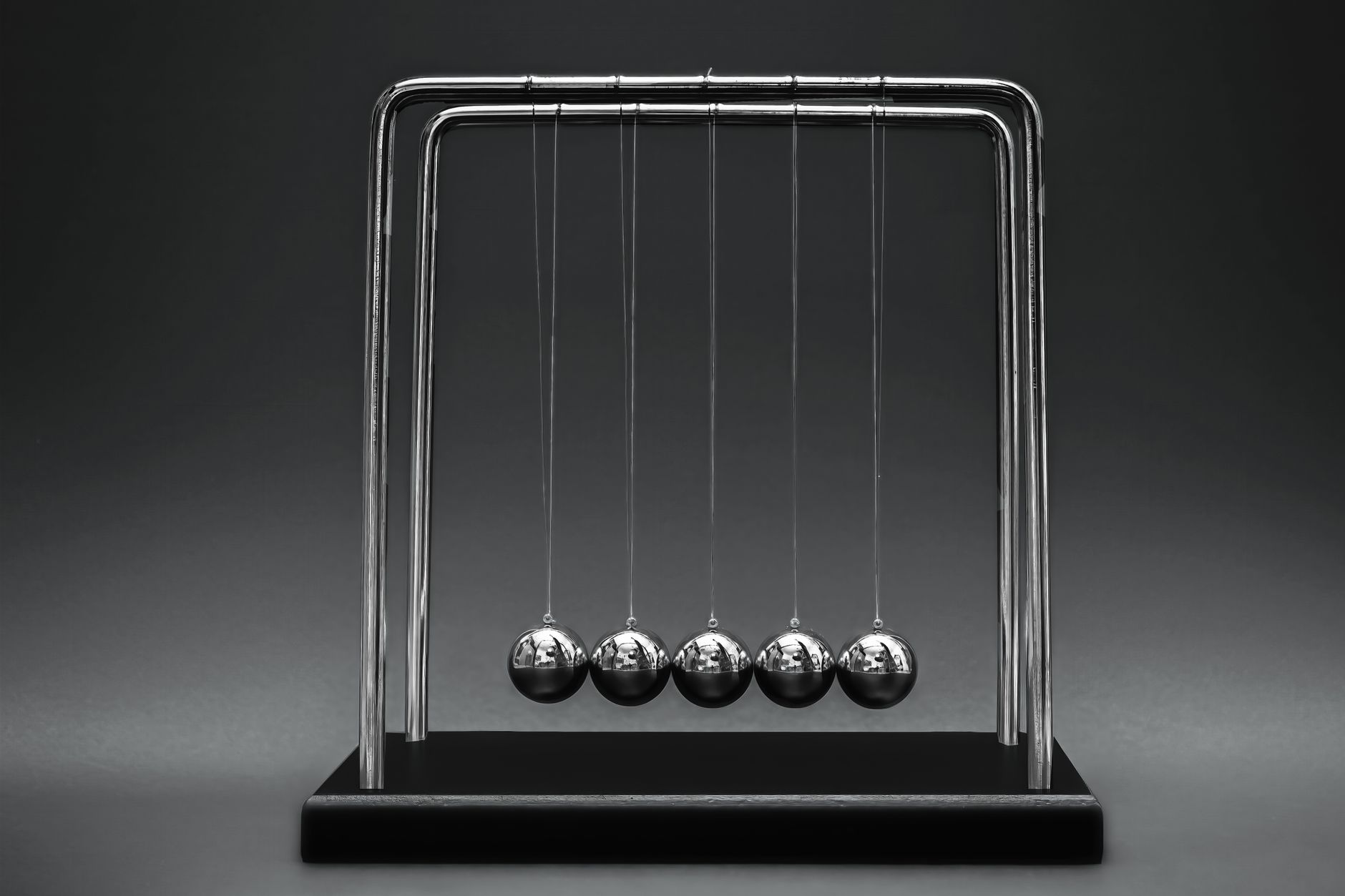
A perfectly ideal Newton's Cradle would swing forever. In reality, every device eventually comes to a stop, and understanding why is just as instructive as understanding why it moves. The primary culprits are air resistance, internal material damping, and acoustic energy loss. Each swing, the balls lose a tiny fraction of their kinetic energy to these dissipative forces, and over time those losses accumulate until the motion ceases entirely.
Air resistance acts on the swinging balls as a drag force proportional to their velocity. Internal damping refers to the microscopic deformation of the steel balls at the moment of impact, even the hardest materials are not perfectly elastic, and a small amount of energy is converted to heat with every collision. The faint clicking sound you hear is itself evidence of energy leaving the system in the form of sound waves.
This gradual decay is a reminder that Newton's Cradle is not a perpetual motion machine, despite sometimes being mistaken for one. It is a beautifully efficient demonstration of energy transfer, but it is ultimately subject to the second law of thermodynamics, entropy wins in the end. If you are interested in exploring other captivating physics demonstrations for your space, we invite you to browse our broader physical science decor collection, where science meets aesthetics in every piece.
Newton's Cradle as a Desk Toy and Educational Tool

Beyond its scientific value, Newton's Cradle has earned a permanent place in popular culture as the quintessential physics desk toy. It signals intellectual curiosity, an appreciation for elegance, and a connection to the history of science. Whether placed on an executive's desk, a professor's shelf, or a student's study table, it invariably sparks conversation and wonder. It is one of those rare objects that is simultaneously decorative and genuinely educational.
As a conservation of momentum desk toy, it has no equal in terms of clarity and immediacy. Abstract equations become visible in real time. Teachers use it to introduce students to elastic collisions, and physicists use it to illustrate concepts that would otherwise require complex mathematical notation. The fact that it requires no power source, no screen, and no instructions makes it universally accessible and endlessly rewarding.
For those who wish to take their desk science one step further, we recommend exploring our classic five-ball steel Newton's Cradle, crafted with precision-polished stainless steel balls for maximum elasticity and a satisfying, long-lasting swing. Whether you are a seasoned physicist or simply someone who appreciates beautiful, meaningful objects, a well-made desk ball pendulum is an investment in daily inspiration.
Choosing the Right Newton's Cradle for Your Space

Not all Newton's Cradles are created equal, and the quality of the device significantly affects the quality of the physics it demonstrates. The most important factors to consider are the material of the balls, the precision of their alignment, and the quality of the suspension strings. Steel balls with a high chromium content offer superior elasticity, meaning more energy is conserved per collision and the cradle swings for longer before coming to rest.
Size also matters more than one might expect. Larger balls carry more momentum and are easier to observe, making them ideal for educational settings or as statement pieces in a living room or office. Smaller, more refined versions are better suited to compact desks where elegance and minimalism are priorities. A well-balanced cradle should swing smoothly and symmetrically for at least 60 to 90 seconds after a single-ball release, anything less suggests poor alignment or low-quality materials.
We also encourage you to consider the aesthetic dimension of your choice. A Newton's Cradle with a solid wood base and mirror-polished balls is a genuinely beautiful object that enhances any environment. It pairs wonderfully with other scientific instruments and decor pieces, creating a cohesive atmosphere that celebrates human curiosity and the beauty of natural law. For more ideas on building a science-inspired space, explore our curated desk toys collection for pieces that are as visually compelling as they are intellectually stimulating.
Conclusion
Newton's Cradle is far more than a desk ornament, it is a living demonstration of some of the most fundamental laws in all of physics, elegantly packaged in a form that anyone can appreciate and enjoy. From the pioneering experiments of Mariotte and Huygens in the 17th century to its status today as the world's most beloved desk ball pendulum, this device has never stopped teaching us something new. The next time you lift one of those gleaming steel balls and let it fall, we hope you will see not just a toy, but a window into the deep order of the universe. Browse our full range of Newton's Cradles and science-inspired decor at science-decor.com, and bring a little physics into your everyday life.


Leave a comment
All comments are moderated before being published.
This site is protected by hCaptcha and the hCaptcha Privacy Policy and Terms of Service apply.