

Elastic vs Inelastic Collisions: The Science Explained
Every time a billiard ball cracks against another, a car bumper absorbs an impact, or the steel balls of a Newton's Cradle swing and click, a fundamental law of physics is playing out right before your eyes. Collisions are among the most universal events in nature, from subatomic particles to galaxies, and understanding them unlocks a deeper appreciation of how the physical world operates. At the heart of every collision lies a critical question: what happens to energy when two objects meet? The answer divides all collisions into two essential categories, elastic and inelastic, and the distinction is far more fascinating than it might first appear.
What Is a Collision in Physics?

In physics, a collision is defined as any event in which two or more objects exert strong forces on each other over a relatively short period of time. This definition is broader than everyday language might suggest, it includes not just dramatic crashes but also the gentle tap of a tennis ball against a racket or even the interaction of two charged particles that never physically touch. The key feature of any collision is the exchange of momentum between the objects involved. No matter what type of collision occurs, momentum is always conserved, provided no external forces interfere.
Momentum, represented by the symbol p, is the product of an object's mass and its velocity (p = mv). When two objects collide in an isolated system, the total momentum before the collision equals the total momentum after. This is one of the most robust principles in all of physics, known as the conservation of momentum, and it applies universally, from the grandest cosmic events to the smallest laboratory experiments. Understanding this principle is the essential first step before exploring what separates elastic from inelastic collisions.
What distinguishes the two types of collisions is not momentum, that is always conserved, but rather what happens to kinetic energy, the energy of motion. In some collisions, kinetic energy is preserved in full. In others, some or all of it is transformed into heat, sound, or deformation. This distinction shapes everything from the design of car safety systems to the way physicists model atomic interactions.
Elastic Collisions: When Energy Is Perfectly Preserved

An elastic collision is one in which both momentum and kinetic energy are conserved. After the collision, the total kinetic energy of the system remains exactly the same as it was before the objects made contact. In practice, this means the objects bounce off each other without any permanent deformation, heat generation, or energy loss to sound or vibration, at least in the idealized sense. True elastic collisions are rare in the macroscopic world, but they serve as an invaluable theoretical model and are closely approximated in several real-world scenarios.
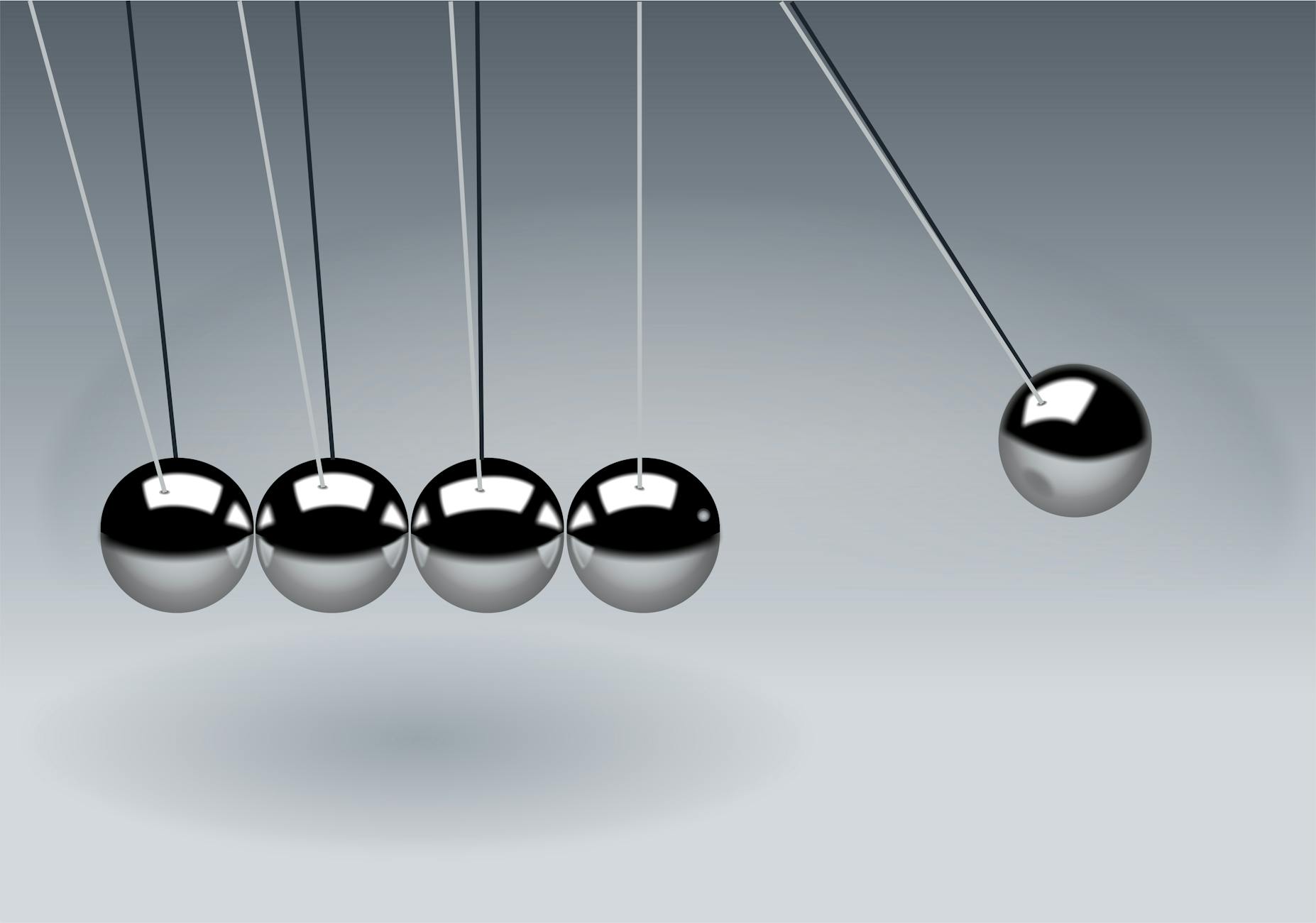
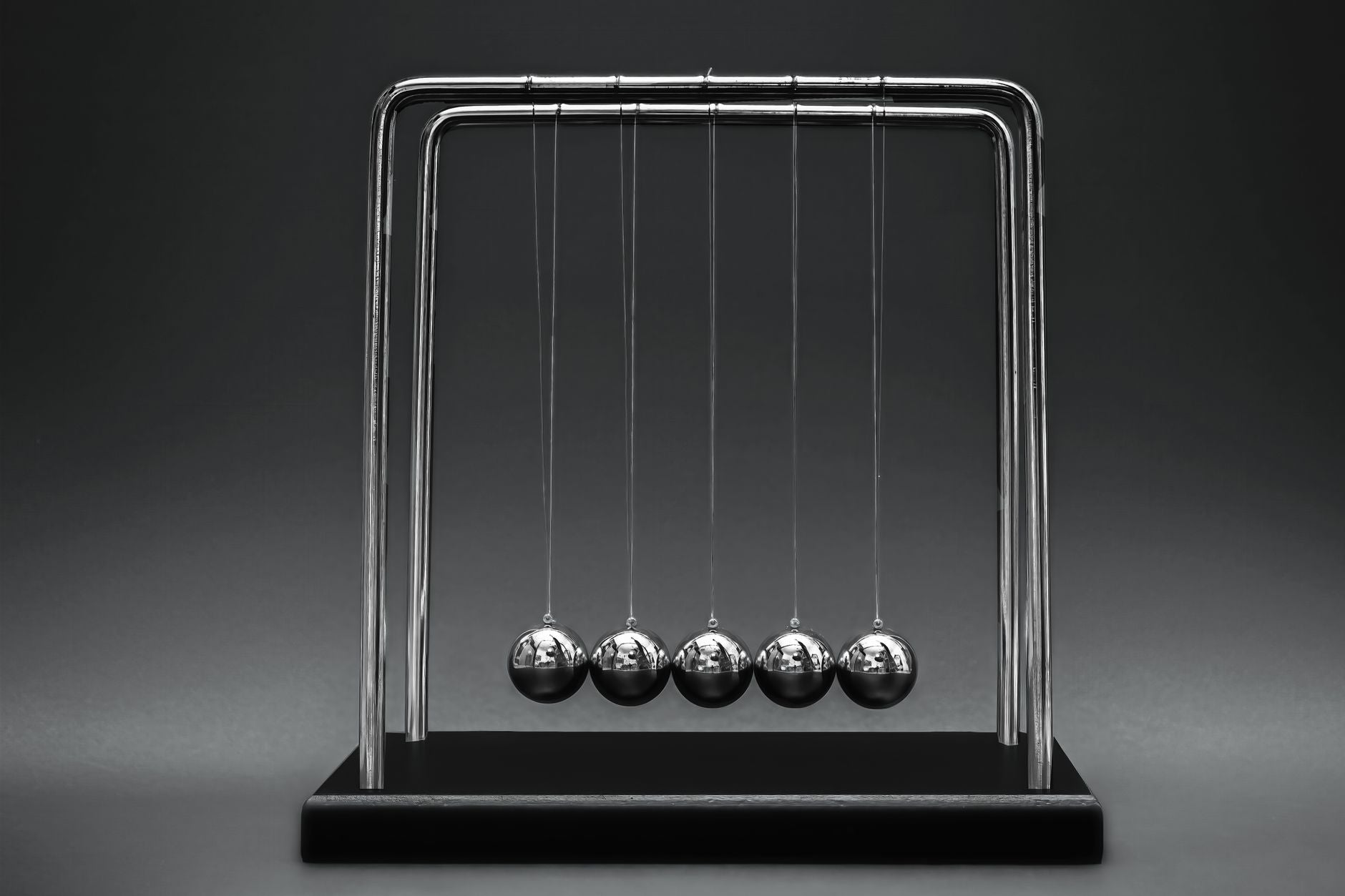
The most celebrated example of a near-elastic collision demonstrator is Newton's Cradle. When you lift one ball and release it, it swings down and strikes the row of stationary balls. The result is striking: the ball on the opposite end swings out with nearly the same speed, while the intermediate balls remain almost motionless. This behavior is a direct consequence of both momentum conservation and kinetic energy conservation working simultaneously. It is why Newton's Cradle has become such an iconic symbol of physics, it makes an abstract law visible and tangible. If you are looking for a beautiful way to bring this principle into your home or office, explore our collection of Newton's Cradles, each crafted to demonstrate this elegant physics with precision and style.
At the atomic and subatomic level, elastic collisions are far more common. When gas molecules collide inside a container, they do so in a nearly perfectly elastic manner, a fact that underpins the entire kinetic theory of gases. In particle physics, collisions between certain elementary particles can also be treated as elastic. The mathematical elegance of elastic collisions lies in the fact that we can write two simultaneous equations, one for momentum and one for kinetic energy, and solve precisely for the final velocities of both objects, making them highly predictable and analytically satisfying.
Inelastic Collisions: When Energy Takes a Different Form
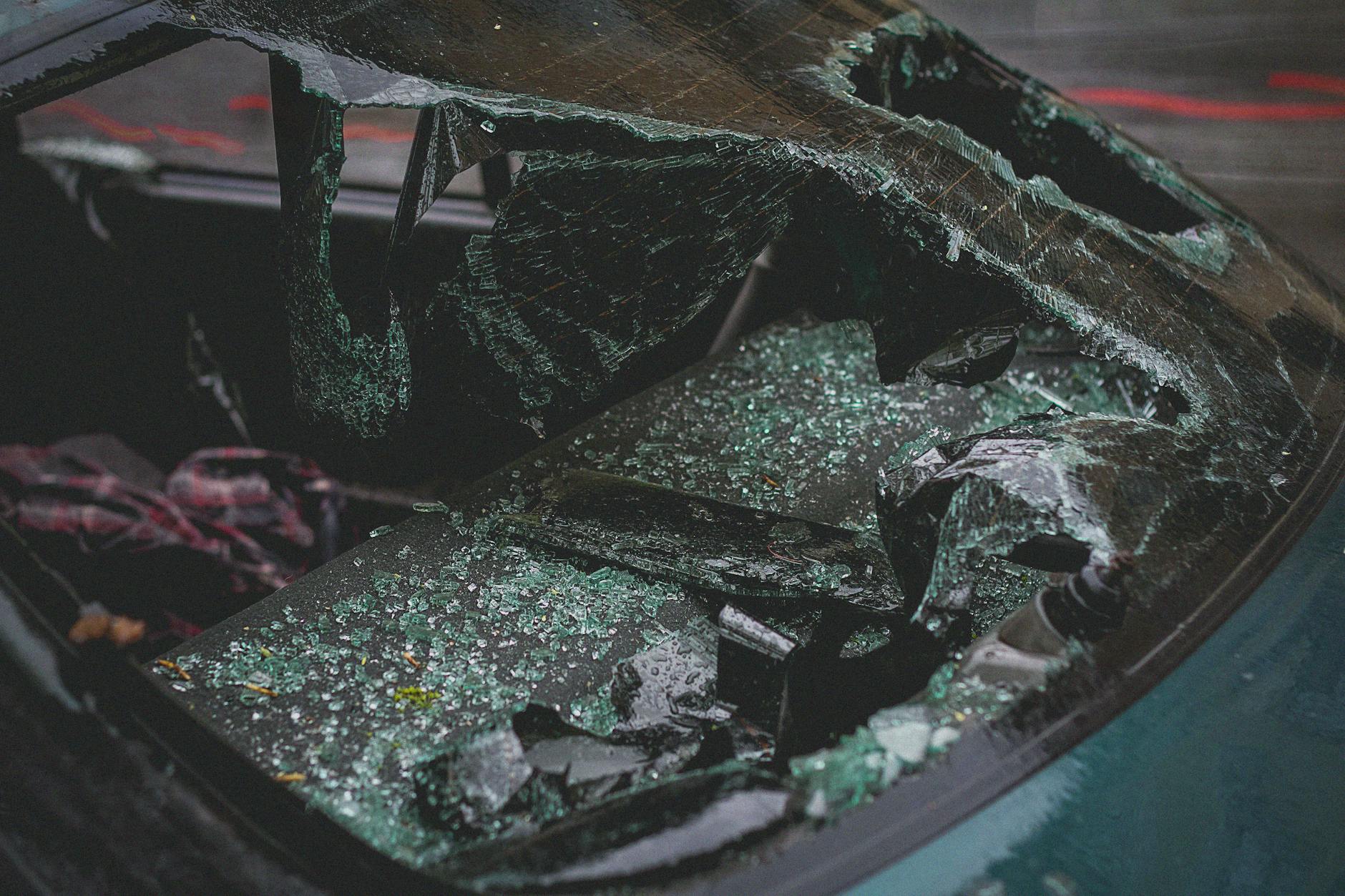
An inelastic collision is one in which momentum is conserved but kinetic energy is not. Some kinetic energy is converted into other forms, most commonly heat, sound, or the energy required to permanently deform a material. This is far more common in everyday life than elastic collisions. When you clap your hands, drop a lump of clay onto a table, or watch a car crumple against a barrier in a safety test, you are witnessing inelastic collisions in action. The kinetic energy does not disappear, it obeys the broader law of conservation of energy, but it is no longer in the form of motion.
The most extreme case is called a perfectly inelastic collision, in which the two objects stick together after impact and move as a single combined mass. Imagine two lumps of modeling clay thrown at each other: they collide, merge, and move together. In this scenario, the maximum possible amount of kinetic energy is lost, though momentum is still fully conserved. This type of collision is actually the easiest to analyze mathematically, because after the collision you only have one object to track rather than two.
It is important to note that most real-world collisions fall somewhere between perfectly elastic and perfectly inelastic, they are simply called inelastic collisions. A rubber ball bouncing on a hard floor loses a small fraction of its kinetic energy with each bounce, which is why it gradually comes to rest rather than bouncing forever. A football tackle, a bat striking a baseball, and a hammer driving a nail are all inelastic collisions where some energy is lost to sound and heat, but the objects do not permanently fuse together. Recognizing these everyday examples deepens one's intuitive grasp of the physics.
Conservation of Momentum: The Universal Rule
Conservation of momentum is the unifying principle that governs all types of collisions, whether elastic or inelastic. It states that the total momentum of a closed system, one with no net external force, remains constant over time. This law is not an approximation or a special case; it is a direct consequence of Newton's Third Law of Motion, which states that for every action there is an equal and opposite reaction. When two objects collide, the force each exerts on the other is equal in magnitude and opposite in direction, so the changes in their individual momenta cancel out perfectly.
Consider a classic conservation of momentum example: a stationary bowling ball struck by a smaller, faster-moving ball. Before the collision, all the momentum belongs to the moving ball. After the collision, that momentum is distributed between both balls, the smaller ball slows down and the bowling ball begins to move. The total momentum of the system (mass × velocity for each ball, added together as vectors) remains the same. This principle is so reliable that engineers use it to design everything from rocket propulsion systems to vehicle crash safety standards.
What makes momentum conservation especially powerful is that it applies even when we do not know the exact forces involved during the collision, as long as the collision time is short and external forces are negligible. This is why physicists love to use it: it provides a clean, powerful constraint on the outcome of any interaction. For those who appreciate the beauty of physical laws made visible, our physics-inspired décor collection celebrates exactly this kind of elegant, timeless science.
Real-World Examples: From Billiard Balls to Car Crashes

Billiard balls are among the most frequently cited examples in discussions of elastic vs inelastic collisions, and for good reason. The hard, smooth surface of billiard balls means very little energy is lost to deformation or heat during impact, making their collisions nearly elastic. When the cue ball strikes a stationary ball head-on, the cue ball stops almost completely and the struck ball moves forward with nearly the same speed the cue ball had. This is a near-perfect demonstration of both momentum and kinetic energy conservation, and it is why billiards is such a satisfying game for the physics-minded observer.
Car crashes, on the other hand, are deliberately engineered to be highly inelastic. Modern vehicles are designed with crumple zones, areas of the car that deform plastically upon impact, absorbing kinetic energy and converting it into the work of deformation. This is not a flaw; it is a life-saving feature. By maximizing the inelastic nature of the collision, engineers ensure that less kinetic energy is transmitted to the passengers. The momentum of the car still changes, but the energy is absorbed by the structure rather than by the human body. This is one of the most important practical applications of collision physics in modern engineering.
Other compelling real-world examples include:
- Superball vs. hard floor: Highly elastic, the ball retains most of its kinetic energy and bounces back nearly to its original height.
- Football tackle: Inelastic, the players briefly merge their motion before separating, with significant energy lost to sound and body deformation.
- Atomic collisions in a gas: Nearly perfectly elastic, the basis of the kinetic theory of gases and the explanation for gas pressure and temperature.
- Meteor impact: Perfectly inelastic, the meteor and the ground fuse, with enormous kinetic energy converted to heat, sound, and crater formation.
Newton's Cradle: A Window Into Collision Physics

No object better bridges the gap between abstract physics and tangible reality than Newton's Cradle. Its elegant simplicity, a row of suspended steel balls that transfer motion from one end to the other, encapsulates both conservation of momentum and conservation of kinetic energy in a single, mesmerizing device. Newton's Cradle is often described as a near-perfect elastic collision demonstrator because the hard steel balls lose very little energy to heat or sound during each impact, allowing the motion to continue for an extended period before gradually dying out due to air resistance and the small amounts of energy lost in each collision.
The physics of Newton's Cradle is actually more nuanced than it first appears. A naive application of momentum conservation alone would allow two balls to swing out when one is released, each moving at half the original speed, and the math would still balance. But kinetic energy conservation rules this out: two balls at half the speed carry only half the kinetic energy of one ball at full speed. The simultaneous requirement of both conservation laws forces exactly one ball to swing out at the original speed, which is precisely what we observe. This interplay between the two conservation principles is what makes Newton's Cradle such a profound teaching tool.
For those who wish to own a piece of this physics history, we recommend our classic chrome Newton's Cradle, a beautifully crafted desktop instrument that brings the elegance of collision physics into any space. Whether displayed in a home office, a classroom, or a living room, it serves as a constant, kinetic reminder that the laws of physics are not just abstract equations on a page, they are alive in every swing of every ball.
Conclusion
Elastic and inelastic collisions are not merely textbook categories, they are the language in which the physical world describes every interaction between objects, from the subatomic to the cosmic. The elastic collision preserves kinetic energy in full, while the inelastic collision transforms it into heat, sound, or deformation, yet both obey the universal law of conservation of momentum without exception. Understanding these principles enriches our perception of everyday phenomena, turning a game of billiards, a car safety test, or the gentle click of a Newton's Cradle into a window onto the deep structure of nature. We invite you to explore the world of physics-inspired décor at science-decor.com, where science is not just studied, it is lived, displayed, and celebrated.

Leave a comment
All comments are moderated before being published.
This site is protected by hCaptcha and the hCaptcha Privacy Policy and Terms of Service apply.