

What Is Conservation of Momentum? The Physics Behind It
Few principles in physics are as elegant, or as universally powerful, as the conservation of momentum. From the silent dance of billiard balls on a felt table to the thunderous separation of a rocket from its launch pad, this law quietly governs the motion of everything around us. Yet despite its importance, momentum is often confused with energy, and the distinction matters enormously. In this article, we will unpack the law of conservation of momentum from the ground up, explore its fascinating history, and show you exactly how a simple desk ornament called Newton's Cradle brings it to life with breathtaking clarity.
What Is Momentum? A Clear Definition

Momentum is defined as the product of an object's mass and its velocity, expressed by the formula p = mv, where p stands for momentum, m for mass, and v for velocity. Because velocity is a vector, meaning it has both magnitude and direction, momentum is also a vector quantity. This means that two objects moving at the same speed but in opposite directions have momenta that point in opposite directions, a subtlety that becomes critical when analyzing collisions.
It is important not to confuse momentum with speed or force. A slow-moving freight train carries enormous momentum because of its massive weight, while a fast-moving tennis ball carries comparatively little. The key insight is that momentum captures both how heavy something is and how fast it is moving, making it a far richer description of motion than speed alone. This dual dependence on mass and velocity is precisely what makes momentum such a useful quantity in physics.
Momentum also differs fundamentally from kinetic energy, even though both depend on mass and velocity. Kinetic energy is proportional to the square of velocity (KE = ½mv²), while momentum is only proportional to velocity itself. This means that doubling an object's speed quadruples its kinetic energy but only doubles its momentum. Understanding this difference is essential when we start asking what happens during a collision, and it is the heart of why Newton's Cradle behaves the way it does.
The Law of Conservation of Momentum Explained

The law of conservation of momentum states that the total momentum of a closed, isolated system remains constant over time, provided no net external force acts upon it. In practical terms, this means that when two objects collide or interact, the combined momentum before the event equals the combined momentum after it. No momentum is created or destroyed, it is simply transferred between objects within the system.
The law emerges directly from Newton's Third Law of Motion, which tells us that every action has an equal and opposite reaction. When two objects exert forces on each other during a collision, those forces are equal in magnitude and opposite in direction, acting for the same duration. As a result, the changes in momentum of the two objects are equal and opposite, and they cancel each other out perfectly when you consider the system as a whole.
This principle is remarkably universal. It applies whether we are talking about subatomic particles colliding in a particle accelerator, two hockey pucks sliding across ice, or galaxies merging over billions of years. The law of conservation of momentum is one of the most tested and verified principles in all of science, holding true across every scale of the physical world that we have been able to observe and measure.
A Brief History: From Descartes to Newton

The story of momentum conservation is a rich chapter in the history of science. The French philosopher and mathematician René Descartes was among the first to propose, in the 1640s, that the total "quantity of motion" in the universe is conserved. He defined this quantity as mass multiplied by speed, a close but imperfect precursor to our modern definition of momentum, since he did not fully account for direction.
The Dutch physicist Christiaan Huygens made a crucial refinement in the 1650s and 1660s through his meticulous studies of colliding balls. Huygens recognized that direction mattered and correctly identified that it was the signed, vector quantity, what we now call momentum, that was conserved in elastic collisions. His work laid the mathematical groundwork that would later be formalized by Newton. Interestingly, Huygens also studied the behavior of pendulums colliding with one another, experiments that directly anticipate the modern Newton's Cradle.
Isaac Newton then unified these ideas within his landmark work Principia Mathematica (1687), deriving the conservation of momentum as a direct consequence of his three laws of motion. Newton's formulation was far more general and rigorous than anything that had come before, and it remains the foundation upon which classical mechanics is built. It is a beautiful example of how scientific understanding accumulates over generations, each thinker building carefully upon the insights of those who came before.
Momentum in Collisions: Elastic vs. Inelastic

When physicists analyze collisions, they distinguish between two fundamental types: elastic collisions and inelastic collisions. In both cases, momentum is conserved, that is the non-negotiable rule. However, the two types differ in what happens to kinetic energy. In an elastic collision, kinetic energy is also conserved, meaning no energy is lost to heat, sound, or deformation. In an inelastic collision, some kinetic energy is converted into other forms of energy, even though total momentum remains unchanged.
A perfectly inelastic collision is the most extreme case: two objects collide and stick together, moving as one combined mass afterward. Here, kinetic energy loss is maximized, yet momentum is still perfectly conserved. Car crashes are a familiar real-world example, crumpled metal and the sound of impact absorb enormous amounts of kinetic energy, but the total momentum of the vehicles before and after the collision remains the same. This is why conservation of momentum is so powerful: it holds even when energy is dissipated in complex ways.
Elastic collisions, on the other hand, are rarer in everyday life but are ideally approximated by objects like hard steel balls or gas molecules. In these interactions, both momentum and kinetic energy are conserved simultaneously, which places two mathematical constraints on the outcome of the collision. These two constraints together determine the velocities of both objects after the collision completely, a result that is both mathematically elegant and physically profound.
Newton's Cradle: The Perfect Physical Demonstration

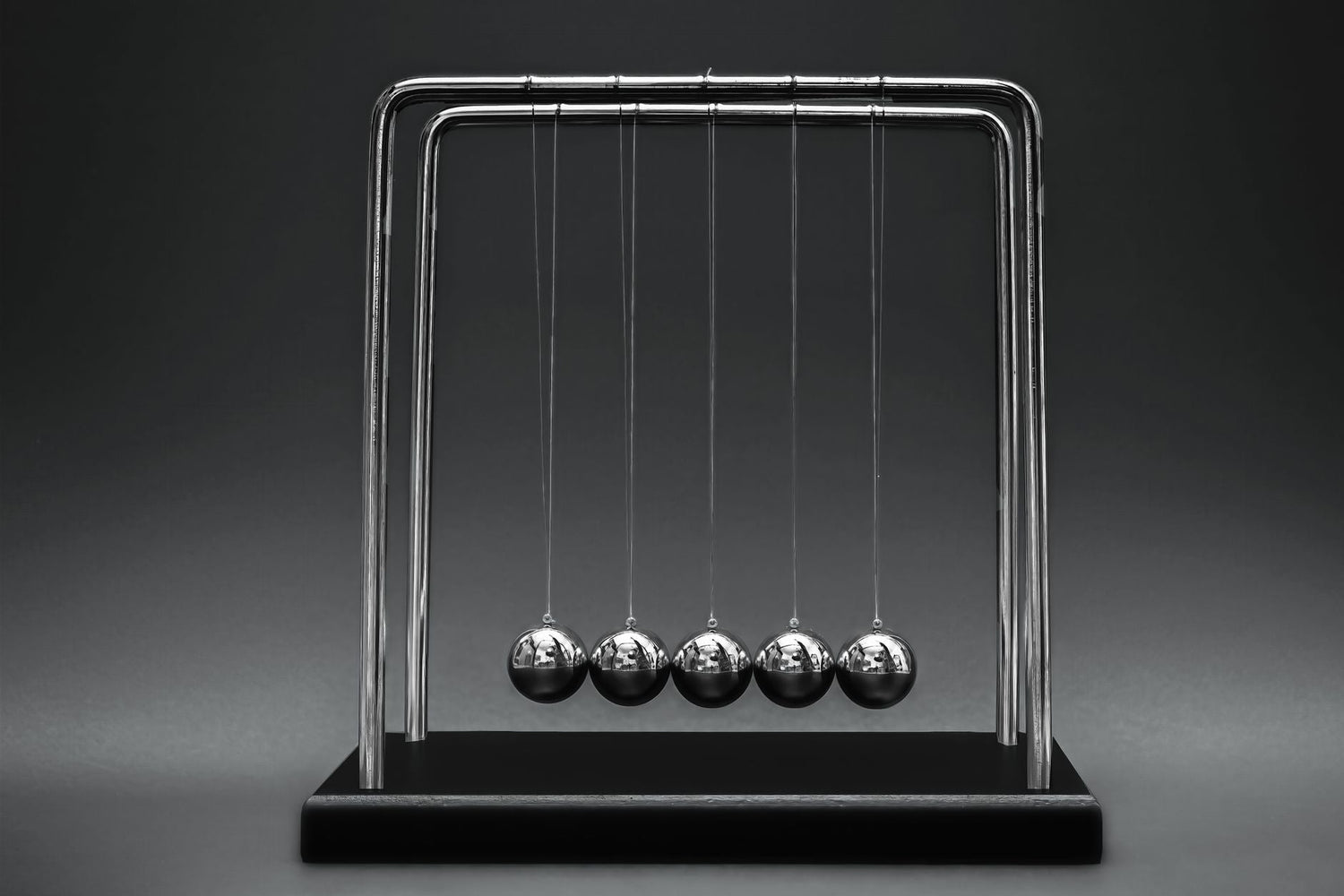
Perhaps no object demonstrates the conservation of momentum and conservation of energy in physics more vividly than Newton's Cradle. This iconic device consists of a row of identical steel balls suspended by strings from a frame, each ball touching the next. When you lift one ball on the end and release it, it swings down and strikes the row, and, almost magically, exactly one ball flies out from the other end with the same speed. The interior balls remain nearly still.
Why does this happen? The answer lies in the simultaneous conservation of both momentum and kinetic energy. If two balls were to fly out instead of one, momentum could still be conserved, but kinetic energy would not be, because two balls moving at half the speed carry only half the kinetic energy of one ball moving at full speed. The system therefore has only one solution that satisfies both conservation laws at once: one ball in, one ball out, at the same speed. Newton's Cradle is a physical equation solver, and its answer is always exact.
This is also why the device is such a beloved piece of scientific decoration. It is not merely a toy or a curiosity, it is a working model of two of the most fundamental laws in physics, operating silently and elegantly on your desk. If you are captivated by this interplay of motion and physics, we invite you to explore our collection of Newton's Cradles, where you will find beautifully crafted versions that make a stunning addition to any home or office. For those who enjoy the broader world of physics-inspired objects, our physical science décor collection offers a wide range of pieces that bring the laws of nature into your living space.
Kinetic Energy and Momentum: Understanding the Difference

One of the most common sources of confusion in introductory physics is the relationship between kinetic energy and momentum. Both quantities describe the motion of an object, and both depend on mass and velocity, yet they behave very differently in physical interactions. As we noted earlier, kinetic energy scales with the square of velocity, while momentum scales linearly. This seemingly small mathematical difference has enormous physical consequences.
Consider what happens when a moving object comes to a complete stop. Its momentum has changed, it has been transferred to whatever stopped it, or cancelled by an opposing force. But where did the kinetic energy go? It was converted into other forms: heat from friction, sound from impact, or deformation of materials. Energy is never destroyed, but it can change form, this is the principle of conservation of energy. Momentum, by contrast, is always conserved as a vector quantity within a closed system, with no "conversion" needed.
Understanding both conservation laws together gives physicists, and curious minds everywhere, a complete picture of how collisions and interactions unfold. For anyone who wants a tangible reminder of these principles displayed with scientific artistry, we recommend our executive five-ball Newton's Cradle, a precision-crafted instrument that makes both momentum and energy conservation visible with every swing. It is the kind of object that sparks genuine curiosity and conversation, whether in a classroom, a study, or a corner office.
Why Conservation of Momentum Still Matters Today
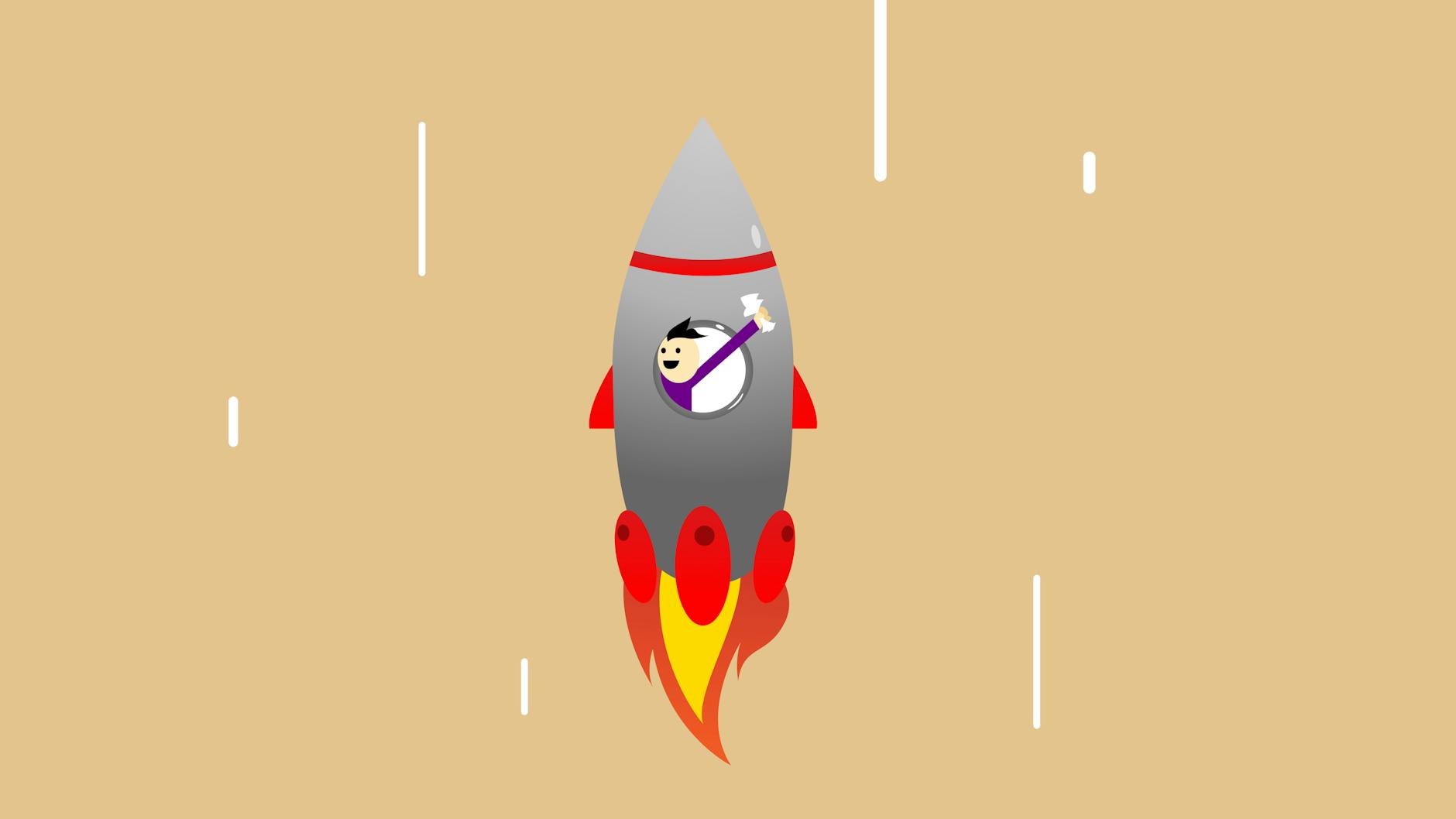
The law of conservation of momentum is not merely a historical curiosity or a classroom exercise, it remains one of the most actively used principles in modern science and engineering. Rocket propulsion is entirely based on conservation of momentum: a rocket expels gas backward at high speed, and the rocket itself accelerates forward in response, with the total momentum of the system remaining constant. Without this principle, space exploration as we know it would be impossible.
In particle physics, conservation of momentum is used to detect invisible particles. When physicists observe a collision in an accelerator and find that the measured momenta of the outgoing particles do not add up to the incoming momentum, they know that an undetected particle must have carried away the missing momentum. This is precisely how the neutrino was first hypothesized in 1930 by Wolfgang Pauli, not by direct observation, but by a gap in the momentum balance. The law is so reliable that a violation of it is treated as evidence of something new, not as a failure of the law itself.
From engineering to astrophysics, from quantum mechanics to everyday life, the conservation of momentum continues to be a cornerstone of our understanding of the physical world. It is a law that connects the motion of subatomic particles to the trajectories of galaxies, unified by the same elegant mathematics that Huygens, Descartes, and Newton first began to unravel centuries ago. The universe, it turns out, keeps very careful accounts of its momentum, and it never loses track of a single unit.
Conclusion
The conservation of momentum is one of those rare scientific principles that is both simple enough to state in a single sentence and deep enough to underpin entire fields of physics. From its historical roots in the work of Descartes and Huygens to its modern applications in rocket science and particle physics, this law has proven itself to be one of the most reliable and far-reaching truths in all of science. Newton's Cradle, with its rhythmic, hypnotic swinging, captures the essence of this principle in a form that anyone can observe and appreciate. We encourage you to keep a piece of this physics on your desk, because the best way to understand a law of nature is to watch it in action, every single day.



Leave a comment
All comments are moderated before being published.
This site is protected by hCaptcha and the hCaptcha Privacy Policy and Terms of Service apply.