


Cool Science Posters: How to Decorate Your Home Office
Your home office should be more than just a functional workspace, it should be a reflection of your curiosity, your passions, and your intellectual identity. Cool science posters are one of the most powerful and affordable ways to transform a plain wall into a source of daily inspiration. Whether you are drawn to the vastness of the cosmos, the elegance of molecular structures, or the beauty of mathematical equations, there is a science poster that speaks to you. In this guide, we walk you through everything you need to know to select, style, and display science wall art in your home office like a true design professional.
Why Cool Science Posters Belong in Every Home Office

Decorating a workspace is not merely an aesthetic exercise, it is a psychological one. Studies in environmental psychology consistently show that surrounding yourself with meaningful imagery improves focus, creativity, and motivation. Cool science posters achieve exactly this by merging visual beauty with intellectual substance, giving your mind something to engage with during moments of pause or reflection. Unlike generic motivational prints, science wall art carries real informational depth that rewards repeated viewing.
Beyond their cognitive benefits, science posters are remarkably versatile from a design standpoint. They come in a wide range of color palettes, from deep indigo astronomy charts to bright periodic table graphics, making it easy to coordinate them with virtually any office interior. Whether your workspace leans minimalist, industrial, or eclectic, there is a science poster that fits seamlessly into the visual language of your room. This adaptability is precisely what makes them such a popular choice among scientists, educators, and curious minds alike.
There is also a social dimension to consider. When colleagues, clients, or friends join you for a video call or an in-person meeting, the art behind you communicates something about who you are. A well-chosen science poster signals intelligence, thoughtfulness, and a love of discovery, qualities that are universally admired. Investing in quality science wall art is, in many ways, an investment in your personal brand as a professional and a thinker.
Choosing the Right Science Theme for Your Space

The first step in building a cohesive science-themed office is selecting a dominant theme that resonates with your personal interests and complements your existing decor. Astronomy posters are perennially popular, featuring breathtaking imagery of nebulae, solar system maps, and star charts that bring a sense of scale and wonder to any room. If your work is more grounded in the physical sciences, physics diagrams, think wave equations, particle physics charts, or blueprints of famous experiments, offer a more technical and cerebral aesthetic. Chemistry enthusiasts, on the other hand, often gravitate toward molecular structure diagrams or beautifully illustrated periodic tables.
You do not need to limit yourself to a single discipline, but we strongly recommend establishing one primary theme and treating others as accents. For instance, a predominantly astronomy-themed office can incorporate a single chemistry poster as a visual counterpoint without feeling disjointed. The key is to maintain a consistent visual tone, whether that means sticking to a monochromatic color scheme, a uniform illustration style, or a shared vintage aesthetic across all your prints. Coherence is what separates a thoughtfully curated space from a cluttered one.
For those who love the intersection of science and art, we particularly recommend exploring our Astronomy collection, which features a curated selection of celestial prints that range from scientifically accurate star maps to artistic interpretations of deep-space phenomena. These pieces work beautifully as standalone focal points or as part of a larger gallery wall arrangement. Whichever theme you choose, make sure it genuinely excites you, because the best home office is one that makes you want to sit down and get to work every single morning.
Aesthetic Science Posters: Finding the Perfect Visual Style

Aesthetic science posters occupy a unique niche where scientific accuracy meets deliberate artistic design. Unlike purely educational charts intended for classroom walls, aesthetic science prints are crafted with composition, typography, and color theory in mind. They are designed to be beautiful first and informative second, which makes them far more suitable for a home environment where visual harmony matters as much as content. When shopping for this style of poster, look for clean layouts, thoughtful use of negative space, and a refined color palette that avoids the garish brightness of traditional educational materials.
Vintage and retro-inspired science posters have surged in popularity in recent years, drawing on the visual language of mid-century scientific illustration. These prints often feature hand-drawn diagrams, serif typography, and muted earthy tones that feel warm and sophisticated rather than cold and clinical. They pair exceptionally well with wooden furniture, leather desk accessories, and warm ambient lighting, a combination that is both intellectually stimulating and deeply comfortable. If your office has a more contemporary feel, you might instead gravitate toward bold, graphic designs with strong geometric elements and high-contrast color schemes.
Another style worth exploring is the data visualization poster, which transforms complex scientific datasets, such as evolutionary trees, climate data, or atomic orbital diagrams, into visually stunning infographics. These pieces tend to attract attention and spark conversation, making them ideal for home offices that double as meeting spaces. The goal with aesthetic science posters is always to find that sweet spot between beauty and meaning, where the artwork rewards both a casual glance and a prolonged, curious study. Browse our Science Posters collection to discover a wide range of styles suited to every taste and interior.
Framing Styles and Display Techniques That Elevate Your Prints
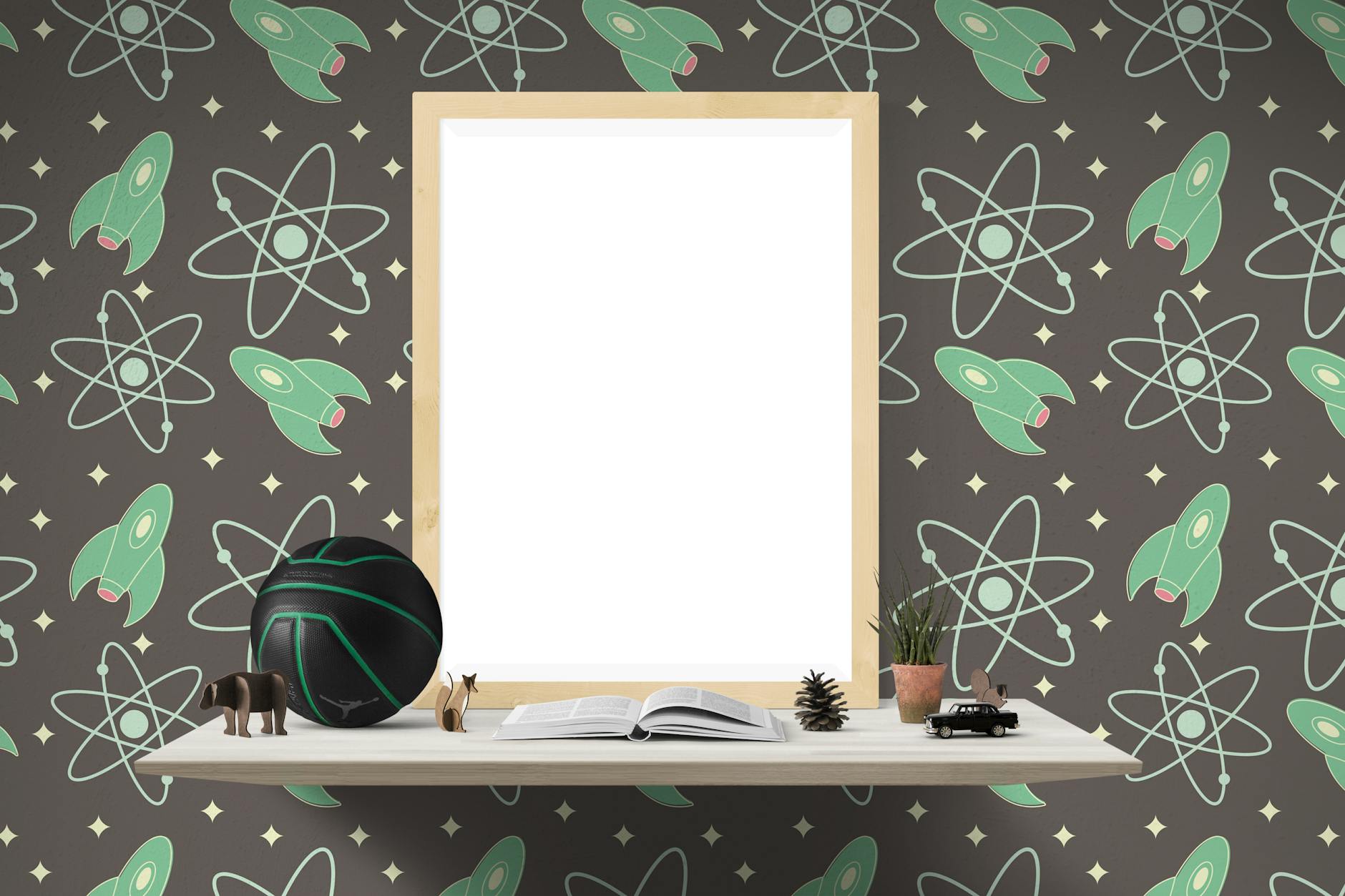
Even the most beautiful poster can fall flat if it is poorly framed or carelessly hung. The frame you choose is as important as the print itself, as it acts as the visual bridge between the artwork and the surrounding decor. For a modern, minimalist office, thin black or white metal frames create a clean, gallery-like presentation that lets the artwork speak for itself. In a warmer, more traditional space, natural wood frames in walnut or oak tones add richness and depth, complementing earth-toned science prints beautifully.
When it comes to matting, the border of paper or cardboard placed between the print and the frame, we recommend always using a white or off-white mat for science posters. A mat adds a sense of formality and importance to the piece, making even an inexpensive print look like a museum-quality work. It also creates visual breathing room around the image, preventing the design from feeling cramped within the frame. As a general rule, the mat should be at least two inches wide on all sides, with a slightly larger bottom margin for a classically proportioned look.
For those who prefer a more casual and contemporary approach, frameless clip frames or poster rails, simple metal or wooden strips that clamp the top and bottom of the print, offer a sleek, unobtrusive display method. These work particularly well for large-format science wall art, where a traditional frame might feel too heavy or dominating. Whatever display method you choose, always hang your posters at eye level, with the center of the artwork approximately 57 to 60 inches from the floor, the standard used by professional galleries worldwide.
Creating a Gallery Wall with Science Wall Art

A gallery wall is one of the most impactful ways to display science wall art in a home office, transforming an entire wall into a curated visual experience. The secret to a successful gallery wall is planning before you pick up a single nail. Start by laying all your frames on the floor and experimenting with different arrangements until you find a configuration that feels balanced and intentional. As a general guideline, keep spacing between frames consistent, typically two to three inches, and ensure that the overall shape of the arrangement has a clear visual boundary, whether that is a rectangle, a horizontal strip, or an asymmetric cluster.
Mixing different sizes of frames adds dynamism to a gallery wall, but it requires careful thought about visual weight. Larger prints should generally anchor the center or bottom of the arrangement, with smaller pieces radiating outward. We recommend including at least one statement piece, a large-format astronomy chart or a dramatic physics diagram, for instance, that serves as the visual focal point around which all other pieces are organized. Varying the orientation of your prints, alternating between portrait and landscape formats, also adds rhythm and visual interest to the overall composition.
Do not be afraid to mix science posters with other types of science decor to add three-dimensional texture to your gallery wall. Small framed specimens, mounted scientific instruments, or even a beautifully designed periodic table with real elements display can be incorporated into a gallery arrangement to create a layered, cabinet-of-curiosities effect. The result is a wall that feels deeply personal, intellectually rich, and visually arresting, exactly what a great home office deserves.
Completing the Look with Science Desk Accessories

A well-decorated home office is never just about the walls. Science desk accessories play a crucial supporting role in creating a cohesive, immersive scientific atmosphere that extends from floor to ceiling. Think of your desk as a three-dimensional extension of your wall art, an opportunity to bring the themes and aesthetic of your posters into the tactile, physical space where you actually work. A vintage brass compass, a set of geometric paperweights, or a beautifully crafted molecular model can echo the visual language of your science prints in a wonderfully tangible way.
When selecting desk accessories to complement your science posters, consider the color palette and material language of your prints. If your wall art features cool blues and silvers, common in astronomy and physics posters, desk accessories in chrome, glass, or dark metal will feel harmonious and intentional. If your posters lean toward warm, earthy tones, as many vintage chemistry illustrations do, wooden accessories, amber glass vessels, and brass instruments will reinforce that warmth beautifully. Consistency in material and color across both wall art and desk accessories is what makes a space feel professionally designed rather than randomly assembled.
For a truly spectacular finishing touch, consider adding a kinetic or interactive science object to your desk. Items like a Newton's Cradle, a magnetic hourglass, or a glowing plasma lamp not only complement the intellectual atmosphere created by your science posters but also serve as genuine conversation starters. These objects bring movement, light, and a sense of living science into your workspace, a reminder that science is not just something to look at, but something to experience. Together with your carefully chosen science wall art, they create a home office environment that is as inspiring as it is beautiful.
Best Practices for Maintaining and Refreshing Your Science Poster Display

Once you have invested time and thought into your science poster display, it is worth knowing how to maintain it properly so that your prints remain vibrant and your space continues to feel fresh. Direct sunlight is the single greatest enemy of printed artwork, causing colors to fade and paper to yellow over time. If your home office receives strong natural light, we strongly recommend using UV-protective glass in your frames, which filters out the harmful wavelengths responsible for fading without significantly altering the appearance of the print. Alternatively, positioning your posters on walls that receive indirect rather than direct light will extend their lifespan considerably.
Dust accumulation on glass frames is another common issue that can dull the appearance of even the most striking science wall art. A quick wipe with a microfiber cloth every two to three weeks will keep your frames looking crisp and clean. Never spray cleaning products directly onto the glass, as moisture can seep under the frame and damage the print; instead, apply a small amount of glass cleaner to the cloth before wiping. For unframed posters displayed on poster rails or clip frames, a gentle dusting with a soft brush is sufficient to keep them looking their best.
Finally, do not underestimate the power of periodically refreshing your display. Swapping out one or two posters every few months keeps your workspace feeling dynamic and prevents visual habituation, the psychological phenomenon whereby we stop truly seeing things we look at every day. Rotating between different science themes, experimenting with new framing styles, or rearranging the layout of your gallery wall are all simple ways to reinvigorate your space without a complete redesign. A living, evolving display is always more inspiring than a static one, and with the breadth of beautiful science prints available today, there is always something new to discover and display.
Decorating your home office with cool science posters is one of the most rewarding investments you can make in your workspace, one that pays dividends in inspiration, focus, and personal expression every single day. By thoughtfully selecting your themes, choosing the right framing styles, building a cohesive gallery wall, and complementing your prints with carefully chosen science desk accessories, you can create a space that truly reflects your love of discovery. We invite you to explore our full range of aesthetic science posters and science wall art at Science Decor, and to let your passion for science shape every corner of your workspace. Your dream home office is just a few well-chosen prints away, start building it today.



Leave a comment
All comments are moderated before being published.
This site is protected by hCaptcha and the hCaptcha Privacy Policy and Terms of Service apply.