

A Lava Lamp Works Because of Convection: Heat Transfer Explained
Few objects capture the imagination quite like a lava lamp, its slow, hypnotic blobs rising and falling in an endless, meditative dance. But behind that mesmerizing motion lies some of the most fundamental physics in the universe: the science of heat transfer. A lava lamp works because of convection, conduction, and radiation, all three modes of thermal energy transfer working together in a single, beautiful device. In this article, we unpack each of these mechanisms in detail, using the lava lamp as our guide to understanding how energy moves through matter, and why that matters far beyond your living room shelf.
The Three Modes of Heat Transfer: A Quick Overview

Before diving into the lava lamp itself, it helps to establish a clear framework. Heat transfer is the movement of thermal energy from a region of higher temperature to a region of lower temperature, and it always occurs through one of three distinct mechanisms: conduction, convection, or radiation. Each mechanism operates differently depending on the medium involved and the physical conditions at play. Understanding all three is essential to fully appreciating why a lava lamp behaves the way it does.
Conduction is the transfer of heat through direct contact between particles, without any bulk movement of matter. Convection involves the physical movement of a fluid, liquid or gas, carrying thermal energy from one place to another. Radiation is the emission of electromagnetic waves that carry energy through space, requiring no medium at all. A lava lamp is a rare and elegant example of a single object that demonstrates all three simultaneously, making it an exceptional teaching tool for physics classrooms and curious minds alike.
It is worth noting that in everyday life, these three modes rarely act in isolation. When you warm your hands by a fire, you experience radiation from the flames, convection from the rising hot air, and conduction if you touch a warm surface nearby. The lava lamp mirrors this complexity in miniature, compressing an entire chapter of thermodynamics into a glowing glass vessel that sits comfortably on a desk or nightstand.
Conduction: How Heat Travels From the Bulb to the Wax

The process begins at the base of the lava lamp, where an incandescent light bulb generates heat. That heat travels upward through the metal base and into the glass vessel primarily through conduction, the transfer of thermal energy via direct molecular contact. In solid materials, atoms and molecules are tightly packed and vibrate in place; when one region is heated, those vibrations become more energetic and are passed along to neighboring particles like a chain reaction. This is exactly what happens in the base of a lava lamp, where heat conducts from the bulb casing into the surrounding materials.
The waxy substance at the bottom of the lamp, typically a blend of paraffin wax and other compounds, absorbs this conducted heat directly from the glass floor of the vessel. Conduction is most efficient in dense, solid materials where particles are in close contact, which is why metals conduct heat far better than wood or plastic. The wax, being a solid at room temperature, initially receives its energy through conduction before anything else happens. This is the quiet, invisible first step that sets the entire lava lamp show in motion.
It is also worth appreciating that conduction is responsible for the lamp eventually reaching a thermal equilibrium when turned off. Once the bulb cools, heat conducts back out of the wax and into the surrounding liquid, then through the glass and into the ambient air. The system always seeks balance, and conduction is the mechanism that enforces it at the molecular level. Without this foundational step, convection and radiation would have nothing to work with.
Convection: The Engine Behind the Lava Lamp's Motion

Convection is the true star of the lava lamp show, and it is the reason the wax moves at all. As the wax absorbs heat through conduction, its molecules gain kinetic energy and begin to move faster, causing the wax to expand and become less dense than the surrounding liquid. Because density determines buoyancy, the less dense wax rises toward the top of the lamp, displaced upward by the denser, cooler liquid around it. This is the fundamental principle of convection: density-driven fluid movement driven by temperature differences.
Once the wax blob reaches the top of the lamp, it moves away from the heat source and begins to cool. As it loses thermal energy to the surrounding liquid and the cooler glass walls, its molecules slow down, the wax contracts, its density increases, and it becomes heavier than the liquid once again. Gravity then pulls the denser wax back down toward the heated base, where the cycle repeats. This continuous loop, rising when hot, sinking when cool, is precisely what scientists call a convection current, and it is the same physical process responsible for weather patterns, ocean circulation, and the movement of Earth's tectonic plates.
The liquid inside the lava lamp is carefully engineered to have a density very close to that of the wax at its operating temperature. This near-perfect density matching is what makes the motion so slow and graceful: the wax barely floats, and barely sinks, hovering in a delicate thermal balance. Lava lamp convection currents are a scaled-down model of some of the most powerful forces on Earth, including mantle convection, where semi-molten rock circulates beneath the crust over millions of years, driving the drift of continents. The same physics, vastly different scales.
Radiation: The Glow That Drives It All
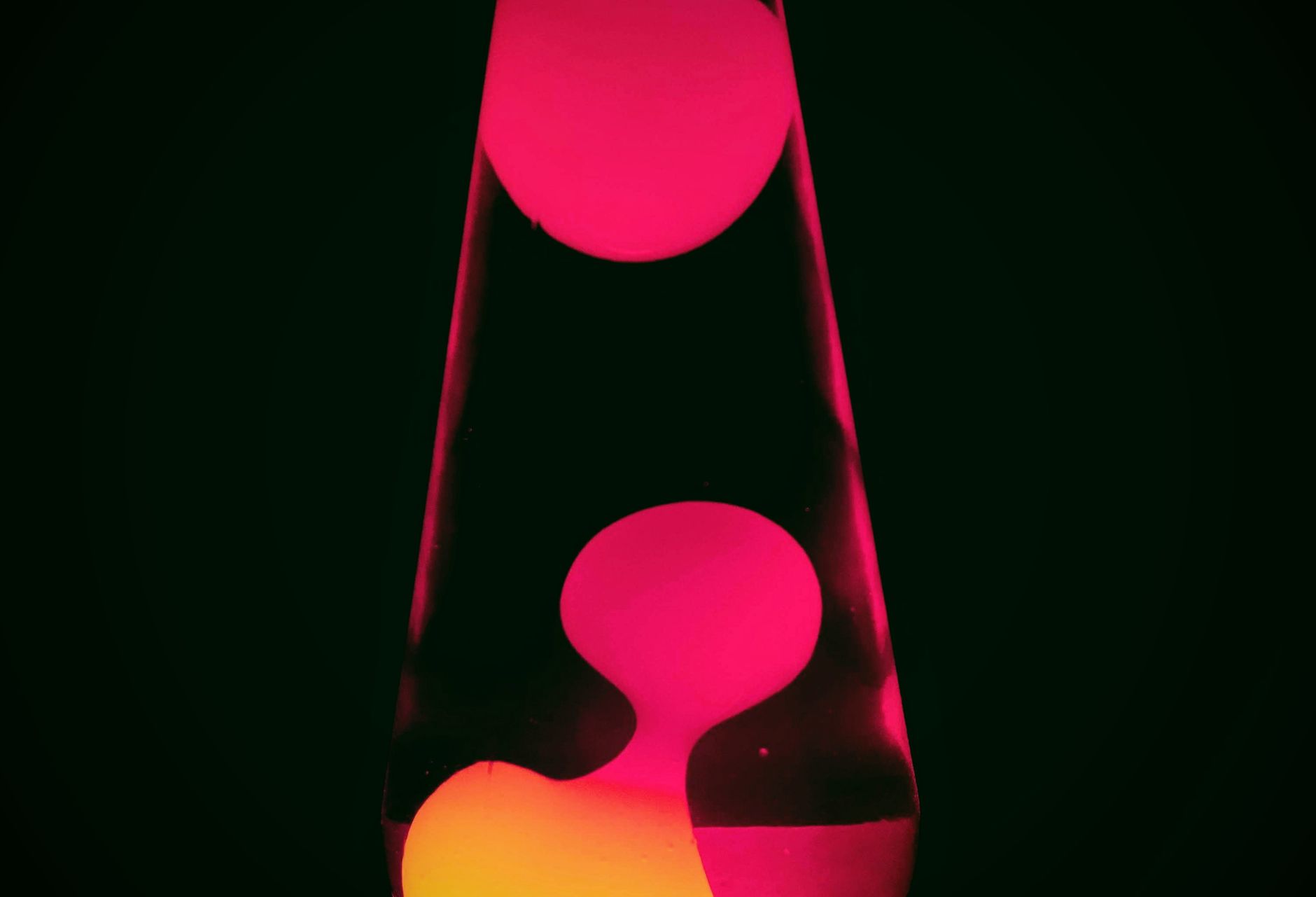
While conduction and convection handle the transfer of heat within and through matter, radiation operates differently, it requires no medium whatsoever. The incandescent bulb at the base of a lava lamp emits electromagnetic radiation, primarily in the form of infrared light and visible light, which travels outward in all directions at the speed of light. Some of this radiant energy is absorbed by the wax and the surrounding liquid, contributing to the overall heating of the lamp's interior. Radiation is therefore a supporting player in the lava lamp's thermal story, but an essential one.
Every object above absolute zero emits some form of thermal radiation, and the hotter the object, the more intensely it radiates. The bulb in a lava lamp reaches temperatures high enough to emit both infrared radiation, felt as warmth, and visible light, which gives the lamp its characteristic glow. This is why lava lamps must use incandescent or halogen bulbs rather than LED bulbs: LEDs are far too energy-efficient, producing very little heat, and without sufficient radiant and conducted heat, the wax simply never melts or rises. The lamp becomes inert, a beautiful glass vessel with no motion at all.
Radiation also plays a subtle role in how the lamp interacts with its environment. The warm glass surface of a lava lamp radiates gentle infrared energy into the surrounding room, contributing to the ambient warmth you may feel when sitting nearby. This is the same principle by which the Sun warms the Earth across 93 million miles of empty space, pure electromagnetic radiation, unimpeded by the vacuum. In this sense, your lava lamp and our nearest star share a common physical language.
A Lava Lamp Is an Example of Real-World Science in Action

A lava lamp is an example of a closed convection system, making it one of the most visually intuitive demonstrations of thermodynamic principles available. Scientists and educators have long recognized its value as a teaching model, precisely because it makes invisible processes visible. The rising and falling blobs of wax are a direct, real-time visualization of density changes driven by heat, something that is otherwise extremely difficult to observe with the naked eye in most natural systems.
Consider the parallels to Earth's mantle. Deep within our planet, rock that is heated by the core becomes slightly less dense and rises slowly toward the crust, while cooler rock near the surface sinks back down. These mantle convection currents are what drive plate tectonics, volcanic activity, and the slow reshaping of continents over geological timescales. The lava lamp is, in miniature, a model of this planetary engine, a fact that makes it not just a piece of decor, but a genuine scientific instrument of imagination. Similarly, ocean thermohaline circulation and atmospheric convection cells follow the same density-driven logic, scaled up to planetary proportions.
If you are fascinated by the intersection of physics and visual elegance, you might also appreciate the Galileo thermometer, another stunning device that uses density-driven buoyancy to measure temperature. Like the lava lamp, it turns an abstract physical principle into something you can watch, appreciate, and understand intuitively. These objects remind us that science is not confined to laboratories, it lives in our homes, on our shelves, and in the objects we choose to surround ourselves with.
Kinetic Molecular Theory: Why Heating Changes Density

To fully understand why the wax in a lava lamp rises when heated, we need to go one level deeper into physics: kinetic molecular theory. This theory states that all matter is composed of particles, atoms and molecules, that are in constant motion, and that the temperature of a substance is a direct measure of the average kinetic energy of those particles. The faster the particles move, the higher the temperature, and the more space they tend to occupy. This relationship between temperature, molecular motion, and volume is the root cause of thermal expansion.
When the wax in a lava lamp absorbs heat, its molecules gain kinetic energy and vibrate or move more vigorously. As molecular motion increases, the average distance between molecules grows, causing the material to expand in volume. Since density is defined as mass divided by volume, and the mass of the wax does not change, an increase in volume means a decrease in density. This is why heated wax becomes less dense than the surrounding cooler liquid, it is not magic, it is molecular physics playing out at a scale we can see with our own eyes.
This same principle governs an enormous range of natural and engineered phenomena. Hot air balloons rise because heated air expands and becomes less dense than the cooler air around it. Thunderstorm clouds form because warm, moist air near the ground rises through convection into cooler upper atmosphere. Even the circulation of blood in the human body is partly influenced by thermal convection at the microscopic level. The lava lamp, in its quiet, glowing way, encapsulates one of the most universal principles in all of physics, and it does so in a form that is as beautiful as it is instructive.
Bringing the Science Home: Lava Lamps as Scientific Decor
Understanding the science behind a lava lamp does not diminish its beauty, if anything, it deepens it. Knowing that each rising blob represents a density-driven convection current, that the glow is electromagnetic radiation at work, and that the entire system is governed by the same laws that shape our planet makes the lamp feel less like a novelty and more like a window into the physical world. Science and aesthetics are not opposites; they are partners, and the lava lamp is one of the most elegant proofs of that partnership.
At Science Decor, we believe that the objects you surround yourself with should inspire curiosity as much as they please the eye. Our lava lamp collection brings together designs that honor both the visual appeal and the scientific heritage of this iconic device. Whether you are furnishing a home office, a classroom, or a creative studio, a lava lamp is a conversation starter, a stress reliever, and a physics lesson all in one. It belongs in any space where ideas are welcome.
For those who want to go even further in decorating with science, we invite you to explore our broader physical sciences collection, where you will find objects that celebrate the beauty of thermodynamics, mechanics, electromagnetism, and more. From Stirling engines to plasma lamps, each piece in our catalog is chosen because it makes a scientific principle tangible, visible, and genuinely wonderful to live with. And if you are looking for a gift that combines elegance with education, our vintage rocket lava lamp is a standout piece that pays homage to the golden age of scientific optimism.
Conclusion
A lava lamp works because of convection, conduction, and radiation, three modes of heat transfer that collaborate in perfect, visible harmony inside a single glass vessel. Conduction heats the wax from below, radiation from the bulb warms the interior, and convection currents carry the wax in its endless, graceful rise and fall, a living demonstration of kinetic molecular theory, density-driven fluid dynamics, and the universal tendency of heat to move from hot to cold. The same physics that animates your lava lamp also drives Earth's weather, its oceans, and the slow drift of its continents. We hope this article has given you a richer appreciation for the science hiding in plain sight on your shelf, and perhaps inspired you to look at the world around you with a little more wonder. Browse our collections and let science illuminate your space.


Leave a comment
All comments are moderated before being published.
This site is protected by hCaptcha and the hCaptcha Privacy Policy and Terms of Service apply.